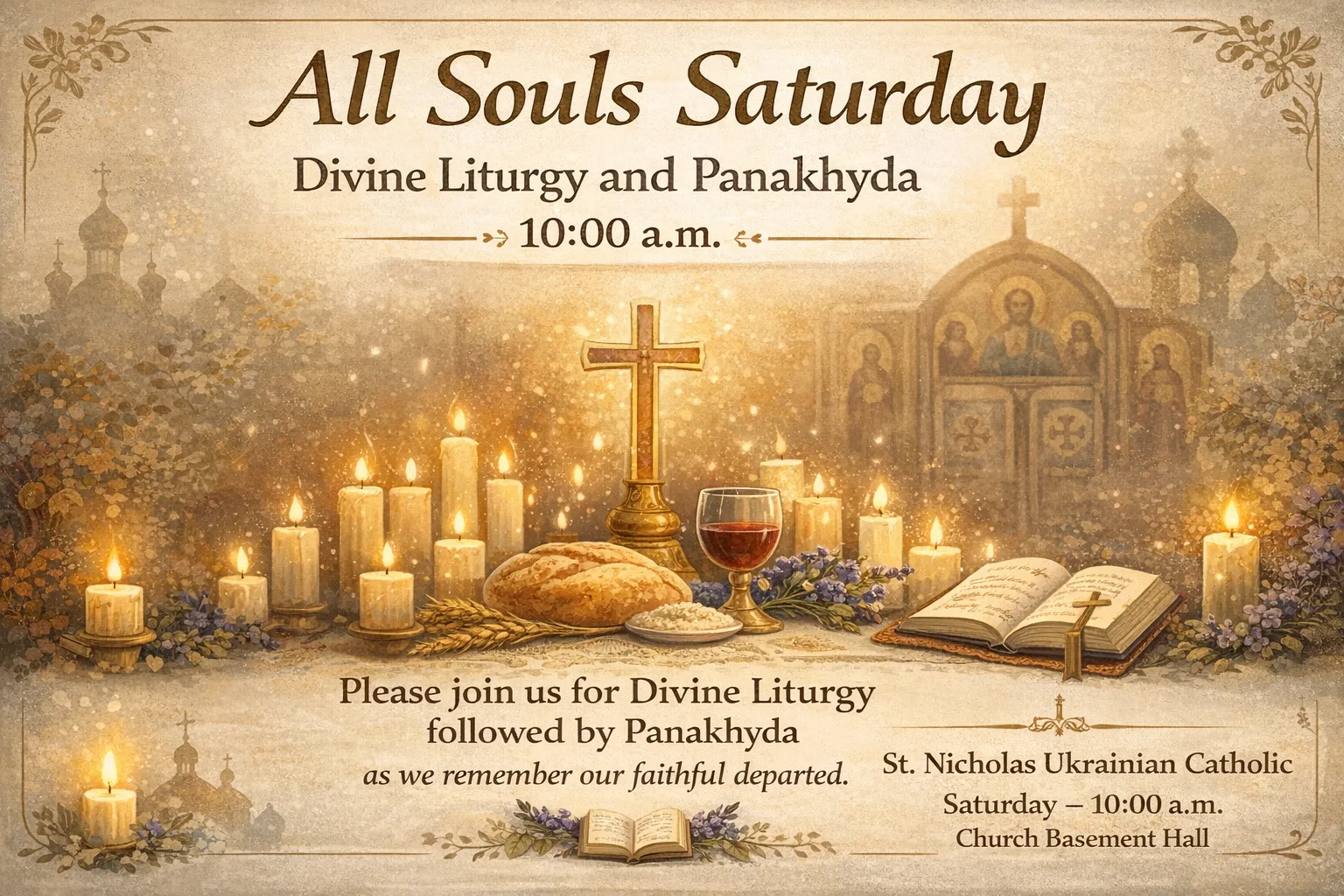
All Souls Saturday (often called a Soul Saturday or Saturday of the Departed) is a day of prayer for all the faithful departed.
On this day, the Church:
offers the Divine Liturgy (or Requiem Mass in the Latin tradition) for those who have died
serves Panakhyda, the memorial service for the departed
prays especially for those who have no one to pray for them
entrusts the departed to God’s mercy, light, and resurrection
This day is not about fear or judgment.
It is about love, remembrance, and hope, rooted in the communion of saints and the Church’s faith that our prayers truly help the departed.
“Memory eternal” is not nostalgia.
It is a prayer that the departed live eternally in God.
From the very beginning, God’s people prayed for the dead, recognizing that this is a holy and wholesome act rooted in faith in the resurrection.
Scripture tells us:
“It was a holy and pious thought to pray for the dead, that they might be delivered from their sin.”
(2 Maccabees 12:44–45)
St. Paul also prays for Onesiphorus, entrusting him to God’s mercy “on that day” (2 Timothy 1:16–18). The early Church continued this practice naturally, offering prayers and the Eucharist for those who had fallen asleep in the Lord.
By the 4th and 5th centuries, Christians:
offered the Eucharist for the dead
gathered at graves
kept lists of names (diptychs) to be commemorated during the Divine Liturgy
In the Byzantine tradition (including Eastern Catholic Churches), these practices developed into fixed liturgical days of universal commemoration, not merely private devotions. One of the most important of these is Meatfare Saturday.
This is deeply theological.
Saturday is the day when Christ rested in the tomb, the day between death and resurrection—a time of quiet hope.
In Byzantine theology:
Sunday is the day of the Resurrection
Saturday is the day of those who await the resurrection
Because Christ rested in the grave on Holy Saturday, Saturday became the Church’s traditional day for commemorating the dead, who now await the final resurrection.
That is why:
Panakhyda is traditionally served on Saturdays
memorial services are usually not served on Sundays
Saturday holds the tension between sorrow and hope—precisely where prayer for the departed belongs.
This is intentional and deeply pastoral.
Meatfare Sunday is the Sunday of the Last Judgment (Matthew 25:31–46) and the final Sunday before the Great Fast begins, when meat is given up.
Before proclaiming the Gospel of judgment, the Church does something profoundly merciful:
👉 She gathers on the Saturday before to pray for the dead.
The sequence teaches us:
We pray for mercy before hearing about judgment
We will be judged together, not alone
Salvation is communal, lived within the communion of saints
Mercy always precedes judgment
All Souls Saturday proclaims that:
the dead are not forgotten
death does not break communion
the Church is one Body in three states:
the faithful on earth
those being purified
the saints in glory
On this day, all three are united in prayer, especially through the Holy Eucharist.
Panakhyda means “all-night vigil,” even when served briefly.
Its prayers ask God to grant the departed:
rest where “there is no sorrow, no sighing”
forgiveness of sins
eternal memory in the light of God’s Kingdom
It expresses the Church’s constant faith that the souls of the departed are helped by the prayers of the faithful, above all by the Holy Eucharist.
“Before we hear about the Last Judgment on Meatfare Sunday, the Church gathers us on Saturday to pray—not to judge, but to love. We stand with our departed brothers and sisters and entrust them to God’s mercy, because no one stands before God alone.”