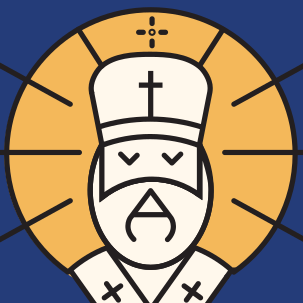
🌅 The Nativity of Saint John the Baptist: The Feast at the Edge of Light
“O Prophet and Forerunner of the coming of Christ, we who lovingly honor you are at a loss to praise you worthily; for your mother’s barrenness and your father’s silence were both ended by your honored and glorious birth, and the incarnation of the Son of God is proclaimed to the whole world.”
— Troparion of the Feast
Every year on June 24, in the midst of the Apostles’ Fast, the Church celebrates one of her oldest and most beloved feasts: the Nativity of the Honourable and Glorious Prophet, Forerunner and Baptist John.
At first glance, it may seem unusual. Why would the Church celebrate the birth of a saint? Normally, saints are commemorated on the day of their death—the day they enter eternal life.
Yet the Church makes only a few exceptions. She celebrates the birth of our Lord Jesus Christ, the birth of the Most Holy Mother of God, and the birth of Saint John the Baptist.
This alone tells us something extraordinary.
John is not simply another saint among many. He stands at the meeting point of the Old and New Covenants. He is the last and greatest of the prophets, and the first witness of Christ. All the prophets pointed toward the Messiah from afar. John pointed to Him standing before him and proclaimed:
“Behold, the Lamb of God who takes away the sin of the world!” (John 1:29)
A Child Promised by God
The Gospel tells us that John’s parents, Zechariah and Elizabeth, were righteous before God but had no children. They were already advanced in years when the Archangel Gabriel appeared to Zechariah while he was serving in the Temple.
The evangelist Luke carefully notes that Zechariah belonged to the priestly division of Abijah. This small detail reminds us that the Gospel is not a legend floating outside of history. God entered a real world, among real people, at a specific moment in time.
Gabriel announced that Elizabeth would bear a son who would be “great before the Lord,” filled with the Holy Spirit even from his mother’s womb, and sent to prepare a people ready for the coming of the Messiah.
Zechariah struggled to believe. As a sign, he lost his ability to speak.
Months later, when the child was born, relatives wished to name him after his father. But Elizabeth insisted, “His name is John.”
When Zechariah wrote the same words on a tablet, his tongue was loosened and his first words became a hymn of praise to God.
The feast hymns beautifully summarize these two miracles:
“Your mother’s barrenness and your father’s silence were both ended by your honored and glorious birth.”
The Child Who Recognized Christ Before Birth
One of the most beautiful moments in all of Scripture takes place before John is born.
When the Virgin Mary visited Elizabeth after the Annunciation, carrying the Savior in her womb, the unborn John leaped for joy.
The Church sees in this event the first witness of the Forerunner.
Before he preached.
Before he baptized.
Before he spoke a single word.
He recognized Christ.
The liturgical hymns of the feast repeatedly return to this mystery: John is sanctified before birth because his entire life exists for one purpose—to reveal Jesus Christ.
The Voice in the Wilderness
John grew up far from the centers of power and influence.
He lived in the wilderness.
He fasted.
He prayed.
He called people to repentance.
Crowds traveled great distances to hear him.
Some even wondered whether he himself might be the Messiah.
Yet John’s greatness is found precisely in his refusal to place himself at the center.
Again and again he points away from himself and toward Christ.
His entire life can be summarized by one sentence:
“He must increase, but I must decrease.” (John 3:30)
No words better capture the spirituality of Saint John the Baptist.
The Feast at the Edge of Light
For centuries Christians have noticed a remarkable harmony between this feast and the natural world.
The Nativity of Saint John falls near the summer solstice, when daylight reaches its greatest length in the Northern Hemisphere.
After this point, the days slowly begin to shorten.
Six months later comes the Nativity of Christ near the winter solstice, when daylight begins to increase once again.
The Church does not present this as scientific proof of historical dates. Rather, Christians have long seen a beautiful spiritual symbolism in the relationship.
John says:
“He must increase, but I must decrease.”
After John’s feast, daylight decreases.
After Christ’s feast, daylight increases.
As if creation itself quietly echoes the mission of the Forerunner.
Ancient Christian tradition linked John’s birth and Christ’s birth through the Gospel of Luke, which tells us that Elizabeth was already six months pregnant when the Archangel Gabriel announced the conception of Jesus. The liturgical calendar preserves this sacred relationship between the Forerunner and the Lord.
What the Church Sings
The theology of this feast is perhaps expressed most beautifully in its liturgical texts.
The Kontakion proclaims:
“She who once was barren gives birth today to the Forerunner of Christ, who will fulfill every prophecy. In the Jordan he placed his hand upon the One whom the prophets foretold and thus was shown to be the prophet, the herald, and the Forerunner of the Word of God.”
The liturgical readings also reveal the deeper meaning of John’s life.
The Old Testament readings at Vespers recall miraculous births granted by God and the promises spoken through the prophets. The Epistle calls believers to cast off the works of darkness and put on the armor of light. The Gospel recounts the angel’s announcement, John’s birth, and Zechariah’s prophecy.
Everything points toward one truth:
John prepares the way.
Christ fulfills it.
John is the voice.
Christ is the Word.
John is the lamp.
Christ is the Light of the world.
A Lesson for Our Time
In a world where people often seek attention, recognition, and applause, Saint John teaches a very different path.
He was admired by thousands.
Yet he never made himself the center.
His greatness came from humility.
His mission was not to draw others to himself, but to lead them to Christ.
That remains his message today.
Every Christian is called, in some way, to become a forerunner.
In our families.
In our parishes.
In our communities.
Not by drawing attention to ourselves, but by helping others encounter the Lord.
A Prayer on the Feast
Holy Prophet, Forerunner, and Baptist John,
you rejoiced in the presence of Christ even before your birth.
Teach us to recognize the Lord as you did.
Help us prepare the way for Him in our hearts.
Give us your courage to speak the truth,
your humility to point beyond ourselves,
and your faithfulness to remain steadfast until the end.
That, like you, we may always proclaim:
“He must increase, but I must decrease.”
Amen.
