Every year on June 29, the Ukrainian Greek Catholic Church celebrates one of the most ancient and solemn feasts of the liturgical year—the Feast of the Holy, Glorious and All-Praiseworthy Leaders of the Apostles, Saints Peter and Paul.
This feast is much more than a remembrance of two remarkable men who lived nearly two thousand years ago. It is a celebration of the living Church founded by Christ Himself—a Church built upon the faith of the Apostles, nourished by the Holy Eucharist, and strengthened by the witness of countless saints and martyrs.
The beautiful hymns of Great Vespers ask:
“What crowns of praise shall we weave for Peter and Paul?”
The answer unfolds throughout the feast itself. Their crowns are not made of gold or precious stones. They are crowns of faith, repentance, sacrifice, missionary zeal, and above all, love for Christ. They remind us of the words of Saint Paul:
“I have fought the good fight, I have finished the race, I have kept the faith. Henceforth there is laid up for me the crown of righteousness.” (2 Timothy 4:7-8)
Peter and Paul did not seek earthly glory. Their only desire was to glorify the Risen Lord.
Few saints appear more different than Peter and Paul.
Peter was a fisherman from the shores of the Sea of Galilee. He earned his living with rough hands, casting nets into the water before Christ called him to become a “fisher of men.” He was spontaneous, courageous, emotional, and deeply human. Sometimes he spoke before thinking. Sometimes his faith was bold enough to walk on water; other times he sank beneath the waves. During Christ’s Passion, he denied knowing his Master three times.
Yet Peter also became the first to proclaim:
“You are the Christ, the Son of the Living God.”
For this confession—not because Peter himself was perfect, but because of the faith he professed—Christ called him the “Rock” upon which He would build His Church.
Paul could hardly have been more different.
Born in Tarsus, educated under the famous Rabbi Gamaliel, Paul possessed one of the finest educations of his time. Before his conversion, he fiercely persecuted Christians, believing he was defending the true faith of Israel.
Everything changed on the road to Damascus.
The Risen Christ appeared to him, asking:
“Saul, Saul, why are you persecuting Me?”
That encounter transformed history.
The persecutor became the preacher.
The enemy became the Apostle.
The scholar became the greatest missionary Christianity has ever known.
One Apostle knew Christ before the Resurrection.
The other met Him after the Resurrection.
One was sent especially to Israel.
The other was sent to the nations.
Yet both preached the same Gospel.
Both celebrated the same Eucharist.
Both died for the same Lord.
Many people wonder why these two Apostles share one feast.
The answer is profoundly theological.
Peter and Paul represent two inseparable dimensions of the Church.
Peter reminds us that the Church must remain faithful to the truth revealed by Christ.
Paul reminds us that this truth must be proclaimed to every nation.
Peter represents stability.
Paul represents missionary movement.
Peter gathers.
Paul sends.
Peter strengthens the Church from within.
Paul carries the Church to the ends of the earth.
The Church needs both.
This is why the Byzantine Church calls them:
“The Leaders of the Apostles.”
Not because the other Apostles were less important, but because Peter and Paul uniquely symbolize the unity and universality of Christ’s Church.
One of the most beloved Byzantine icons shows Peter and Paul embracing each other.
At first glance it appears to be a simple greeting.
It is much more.
The embrace is a theological statement.
The New Testament tells us that Peter and Paul once disagreed publicly in Antioch concerning pastoral practice (Galatians 2).
Yet they remained united in faith.
Their embrace teaches something desperately needed today:
Christians may have different personalities, gifts, opinions, and cultures.
But we must never lose communion in Christ.
Truth without love becomes harsh.
Love without truth loses its foundation.
Peter and Paul embrace because both are necessary.
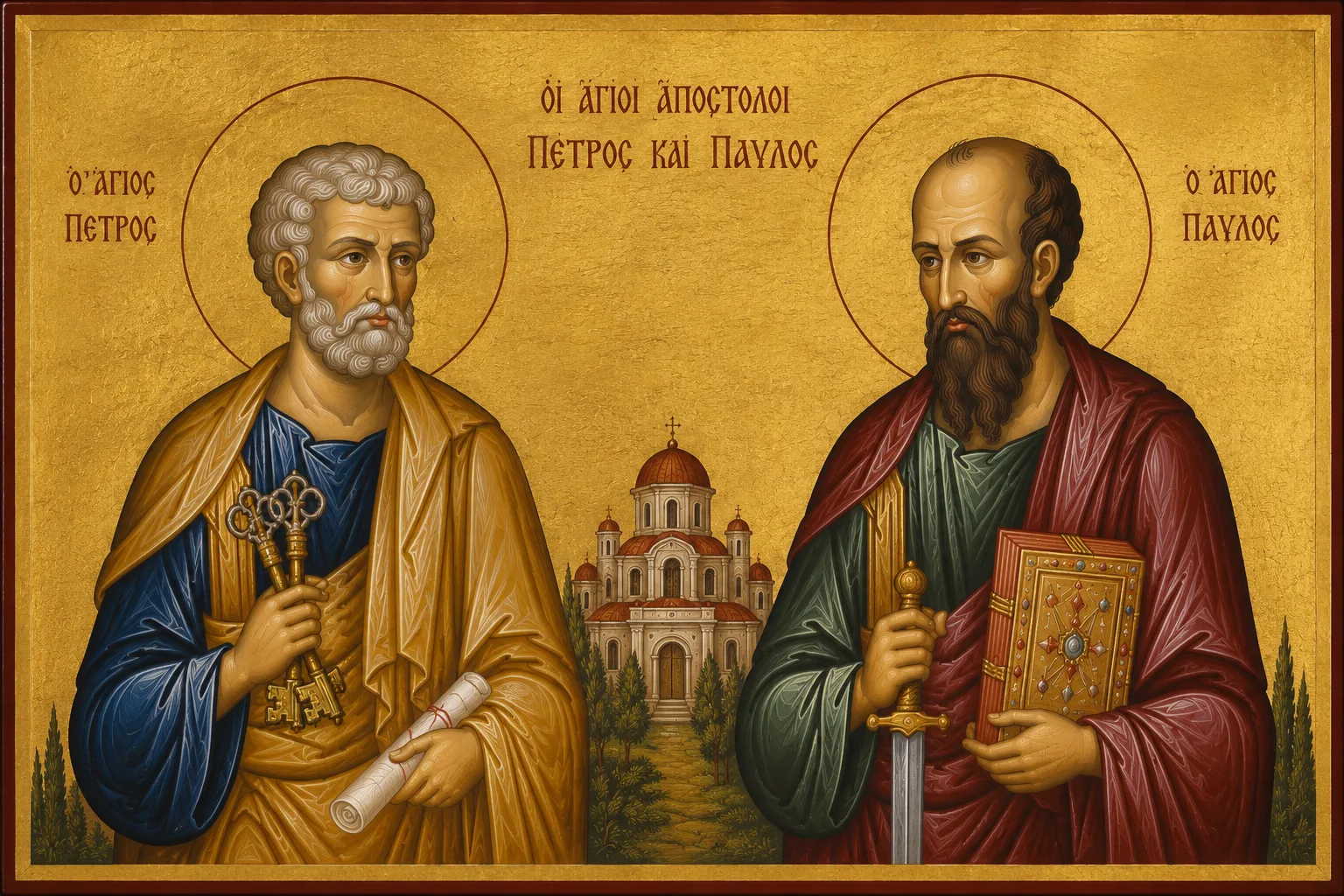
Every detail in a Byzantine icon teaches the faith.
Peter is usually shown with short, curly grey hair and a rounded beard. In his hands he often holds the keys entrusted to him by Christ.
The keys do not mean Peter “owns” heaven.
Rather, they symbolize Christ entrusting His Church with the ministry of reconciliation, forgiveness, and pastoral care.
Paul is recognized by his high forehead, dark pointed beard, and thoughtful expression.
He often carries either the Book of the Gospels or a scroll.
Sometimes he also holds a sword.
The sword reminds us of his martyrdom by beheading under Emperor Nero.
More importantly, it represents what Paul himself called:
“The sword of the Spirit, which is the Word of God.” (Ephesians 6:17)
His greatest weapon was never steel.
It was the Gospel.
One of the treasures of the Byzantine Church is that theology is sung before it is studied.
Our liturgical hymns are not poetry alone.
They are prayer.
They are doctrine.
They are catechism.
During Vespers we hear Peter and Paul called:
“The two greatest luminaries of the Church.”
Why luminaries?
Because Christ is the Light of the World.
The Apostles do not produce their own light.
Like the moon reflecting the sun, they reflect the glory of Christ.
Another hymn calls them:
“The wings of the knowledge of God.”
What a beautiful image!
Birds use wings to rise above the earth.
The Apostles carried the Gospel beyond the borders of Israel until it reached the whole Roman Empire.
Through their preaching countless souls learned to fly toward heaven.
Ancient Christian tradition tells us that both Apostles died during the persecution of Emperor Nero around AD 64–67.
Peter was crucified.
According to ancient tradition, he requested to be crucified upside down because he did not consider himself worthy to die exactly as Christ had died.
Paul, as a Roman citizen, was not crucified.
He was beheaded by the sword.
Neither death was a defeat.
Their blood became the seed of the Church.
As the early Christian writer Tertullian famously observed:
“The blood of the martyrs is the seed of Christians.”
Even today millions of pilgrims pray at the tombs of both Apostles in Rome.
Their witness continues to strengthen the Church throughout the world.
Long before the joyful celebration comes the Apostles’ Fast.
In Ukrainian tradition it is lovingly called Petriwka.
Unlike the Great Fast before Pascha, this fasting period has a distinctly missionary character.
After receiving the Holy Spirit at Pentecost, the Apostles prepared themselves through prayer before going into the world.
The Church invites us to do the same.
Fasting is never about dieting.
It is about freedom.
When we fast, we discover that Christ is more necessary than comfort.
When we pray, we discover that His voice is stronger than the noise of the world.
When we confess our sins, we discover that His mercy is greater than our failures.
This is why the Apostles’ Fast prepares us not merely for a feast day, but for renewed discipleship.
Among Ukrainian Christians, the Feast of Saints Peter and Paul has always marked an important moment in the rhythm of summer.
After the discipline of Petriwka, families gathered around festive tables, thanking God for the fruits of the earth and praying for favourable weather during the harvest season.
Many villages throughout Ukraine bear the names of Saints Peter or Paul, and countless churches are dedicated to these beloved Apostles.
Pilgrimages, parish feasts (praznyky), outdoor processions, and community gatherings became joyful expressions of faith and gratitude.
Our ancestors understood something we should never forget:
A feast is not simply a day off.
It is a day set apart for God.
The celebration begins at the Divine Liturgy.
Everything else flows from there.
Jesus gave him the name Peter, meaning “Rock,” after Simon professed his faith in Christ.
His letters continue to guide Christians nearly two thousand years later.
The Gospels tell us that Jesus healed Peter’s mother-in-law (Matthew 8:14), reminding us that Christ calls people from every walk of life to holiness.
Christians painted them while persecution was still taking place, expressing their hope in the Resurrection.
It reminds us that true unity is always rooted in Christ, even when people have different personalities and gifts.
Peter teaches us never to lose hope after failure.
Paul teaches us never to think anyone is beyond God’s mercy.
Together they remind us that holiness is not reserved for perfect people.
It is the work of God’s grace in hearts willing to say “yes.”
Every Divine Liturgy continues the mission that began with the Apostles.
Every time we hear the Gospel, receive the Holy Eucharist, forgive one another, serve those in need, or witness to Christ by our lives, we continue the apostolic mission entrusted to the Church.
As we celebrate this great feast, let us ask the Holy Apostles Peter and Paul to strengthen our parish, our families, our Ukrainian Greek Catholic Church, and every Christian throughout the world.
May they teach us to love Christ with Peter’s heart, proclaim Him with Paul’s courage, and remain faithful until the day when we too may receive the unfading crown of glory promised to all who persevere in faith.
Holy, Glorious and All-Praiseworthy Leaders of the Apostles, Peter and Paul, pray to God for us!