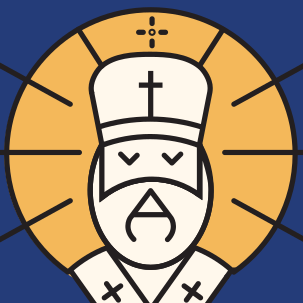
The Beheading of Saint John the Baptist
August 29 — A Feast of Truth, Courage, Fasting and Remembrance
Saturday, August 29, 2026
🕀 The Beheading of the Honourable and Glorious Prophet, Forerunner and Baptist John
All-Night Vigil Feast
Among the great feasts of our Byzantine Christian tradition, the Beheading of Saint John the Baptist is one of the most solemn. It is not a joyful feast in the ordinary sense. We gather to remember the martyrdom of the one whom Christ called the greatest born of woman.
Saint John died because he refused to remain silent in the face of sin.
He told King Herod plainly:
“It is not lawful for you to have your brother’s wife.”
John could have protected himself by remaining quiet. He could have pleased the king. Instead, he remained faithful to God’s truth — and paid for it with his life.
The Church therefore remembers him not simply as a prophet, but as a martyr for truth.
The Ukrainian Greek Catholic Church continues to celebrate this feast on August 29 according to the revised calendar. The 2026 UGCC calendar lists the Beheading of Saint John the Baptist on August 29 with the Vigil and the Divine Liturgy readings from Acts 13 and Mark 6.
Why is this feast celebrated?
The Gospel tells us the tragic story.
King Herod had taken Herodias, the wife of his brother, as his own. Saint John publicly condemned this unlawful relationship. Herod therefore imprisoned John.
During a banquet, Herodias’ daughter danced before the king and his guests. Herod, carried away by the moment, promised to give her whatever she asked. At her mother’s urging, she asked for the head of John the Baptist.
Herod knew that John was righteous. He was troubled by the request, but because of his pride, his promise and his concern about what his guests would think, he gave the order.
John was beheaded in prison.
His disciples came, took his body and buried him.
This terrible event is the reason why this day is observed with such seriousness.
The Church’s hymns, however, do not end the story with John’s death. The Kontakion reminds us that the Forerunner continued to proclaim Christ even to those in Hades. His death was not the victory of Herod. Truth was not defeated.
As the Ukrainian Greek Catholic Synod has recently emphasized, John’s death was not a defeat but a victory of truth over human evil and fear.
Why is August 29 a fasting day?
The Beheading of Saint John the Baptist is traditionally observed as a strict fast because we are remembering the violent death of the Lord’s Forerunner. This practice is shared broadly throughout the Byzantine Christian tradition.
The fast is not meant to be a punishment.
It is a way of saying:
“Today I remember what happened. I remember the cost of sin. I remember the courage of God’s servant. And I want to examine my own life.”
Our fasting should therefore lead us to prayer, repentance, simplicity and charity.
It is especially appropriate on this day to ask:
- Where am I afraid to speak the truth?
- Where do I compromise my Christian principles because I want people to like me?
- Have I allowed pride, anger, pleasure or alcohol to control me?
- Do I have the courage of Saint John to say what is right?
- Do I need to repent and return to God?
The fast is not simply about what we put out of our mouths. It is also about what comes out of our mouths.
Perhaps on this day we should fast not only from certain foods, but also from gossip, complaining, anger, insults and unnecessary arguments.
Why do people traditionally avoid using a knife?
This is one of the most interesting customs associated with the feast.
In many Ukrainian and other Eastern European traditions, people traditionally avoided using a knife, axe or other sharp tool on the day of the Beheading.
Food was not cut with a knife. Bread could be broken by hand. Some foods were prepared in a way that did not require cutting.
The reason is simple: the knife reminded people of the instrument used to take John’s life.
This custom is found in several Eastern Christian cultures. Some traditions also avoided serving food on a large flat platter because Saint John’s head was presented to Herodias on a platter.
This is a beautiful example of how our ancestors tried to make the Gospel concrete.
They did not simply hear the story in church.
They remembered it at the kitchen table.
Which fruits and vegetables were traditionally avoided?
Here the customs become especially interesting — and sometimes quite different from one Ukrainian village or region to another.
Many people traditionally avoided round fruits and vegetables, because their shape reminded them of a human head.
These could include:
- apples
- pears
- onions
- garlic
- cabbage
- potatoes
- pumpkins
- melons
- watermelons
Some Ukrainian traditions also avoided red foods, such as tomatoes, red peppers, red apples and red wine, because the colour reminded people of blood.
Cabbage received special attention in some traditions because it is round and because folklore connected its shape and leaves with the story of John’s beheading.
Some communities even avoided borscht on this day. The explanation varied: the vegetables were cut, some were round, and the red colour of the soup reminded people of blood.
But it is important to understand this correctly:
The Church does not teach that an apple, onion, cabbage or tomato is sinful on August 29.
These are traditional devotional customs, not universal Church laws.
The actual spiritual meaning is much more important than the vegetable.
If someone eats an apple on August 29, they have not committed a sin.
If someone avoids an apple but spends the day gossiping, judging others and refusing to forgive, they have missed the point of the feast.
Why avoid dancing and loud celebrations?
Another old custom was to avoid dancing, singing and noisy celebrations.
The reason comes directly from the Gospel.
John’s death occurred because Herod was carried away by a banquet, his passions, the dancing of Salome, alcohol, pride and the desire to impress his guests.
Therefore, popular Christian tradition turned away from these things on this solemn day.
Some communities also avoided celebrating birthdays or holding large parties because Herod’s birthday banquet became the setting for John’s murder.
Again, this is a traditional devotional practice rather than a universal Church prohibition.
The message is more important than the rule:
Do not let pleasure, pride or the opinion of other people make you forget what is right.
Even the kitchen could become a place of remembrance
Our Ukrainian ancestors had a very practical faith.
On this day, even preparing food could become a reminder of the Gospel.
Instead of cutting bread, they broke it.
Instead of using a knife to cut fruit, they might leave it aside.
Instead of preparing a large and elaborate meal, they kept the table simple.
The purpose was not superstition.
The purpose was remembrance.
The family could look at the simple table and remember:
John gave his life because he would not betray God’s truth.
That is why some old customs may seem strange to us today, but behind them was a very human desire: to make faith part of everyday life.
The Feast and the Beginning of Autumn
In Ukrainian folk tradition, the Beheading of Saint John was also connected with the changing of the seasons.
By the end of August, the harvest was being gathered, the days were becoming shorter, and people could feel that summer was coming to an end.
The day was therefore sometimes associated with the beginning of autumn and the preparation for the colder months.
This gave the feast another meaning: a reminder that earthly seasons change, and human life also passes.
The Church’s Kontakion makes the same spiritual point when it contrasts the “false and transitory age” with the life that comes from God.
Everything around us changes.
Our health changes.
Our work changes.
Our families change.
Our possessions disappear.
But God’s truth remains.
What should we actually do on this feast?
The best traditions are those that lead us closer to Christ.
On August 29, we can:
Go to Divine Liturgy.
The feast is marked in the UGCC calendar as a major celebration, with Vigil and Divine Liturgy.
Keep the fast.
Choose simple fasting food and remember why you are fasting.
Pray for courage.
Ask Saint John to help you remain faithful when it is difficult to do what is right.
Examine your conscience.
Where have you compromised God’s truth because you were afraid of what others would say?
Avoid unnecessary celebrations and excess.
Keep the day quiet and prayerful.
Give something to someone in need.
Our ancestors often connected solemn feast days with charity and hospitality.
Forgive someone.
Saint John preached repentance. His feast should move us toward repentance in our own lives.
Teach the children.
Tell them the story of Saint John. Explain why we fast. Explain why some people traditionally avoided knives and certain foods. Let them see that our faith is not only something we do in church.
Tradition and Faith: What should we remember?
There is a great deal of folklore surrounding the Beheading of Saint John the Baptist.
Some customs are beautiful reminders of the Gospel. Others developed from local beliefs and symbolism. Some are different from village to village.
We should therefore not turn every old custom into a religious law.
The Church asks us to fast and remember the martyrdom of Saint John.
Our ancestors added customs to help themselves remember.
The knife reminded them of the sword.
The round apple reminded them of the head.
The red food reminded them of blood.
The simple table reminded them of John’s life of simplicity.
The silence reminded them of the tragedy of Herod’s banquet.
These customs can still teach us something — if we understand what they are meant to teach.
Saint John: A Man Who Would Not Compromise
Perhaps this is the most important lesson of the feast.
Herod knew John was a righteous man.
The Gospel even tells us that Herod liked listening to him.
But Herod could not bring himself to obey the truth.
He was more concerned about his guests than about God.
That is a danger for all of us.
Sometimes we know what is right, but we are afraid to do it.
We know we should apologize.
We know we should stop gossiping.
We know we should tell the truth.
We know we should go to confession.
We know we should change something in our life.
But then we think:
“What will people say?”
Saint John shows us another way.
He chose God’s truth.
He paid a great price.
But he did not lose.
The Church still remembers his name.
Herod’s banquet is forgotten.
John’s witness remains.
A Feast for Our Own Time
The Beheading of Saint John the Baptist is not only a story from the past.
We live in a world where truth is often uncomfortable.
There are times when Christians must choose between being popular and being faithful.
Saint John reminds us that Christian courage does not mean being rude, angry or aggressive.
It means being faithful.
It means speaking the truth with love.
It means refusing to call something good when God tells us that it is wrong.
It means being willing to stand alone when necessary.
And it means remembering that this life is not the final word.
Saint John lost his earthly head, but he did not lose his soul.
He lost his life, but he gained the life that never ends.
A Prayer to Saint John the Baptist
Holy Prophet, Forerunner and Baptist John,
you were not afraid to speak the truth before powerful people.
Pray for us, that we may have courage to live according to God’s commandments.
Help us not to compromise our faith because of fear, pride or the opinion of others.
Teach us to repent when we fall, to speak truth with love, and to remain faithful to Christ until the end.
Through your prayers, may we become faithful witnesses of the Gospel in our families, our workplaces and our communities.
Holy John the Baptist, pray for us!
Glory be to Jesus Christ!
Glory be forever!
A final thought
This Saturday, when we hear the Gospel of the Beheading of Saint John, perhaps we can remember more than the old customs.
We can remember the reason behind them.
If we break bread with our hands, let us remember John.
If we keep the fast, let us remember John.
If we put away the knife, let us remember John.
If we choose a quiet evening instead of a noisy celebration, let us remember John.
But above all, let us remember what John died for:
the truth of God.
May Saint John the Baptist teach us that no earthly power, no popularity and no temporary pleasure is worth losing our friendship with God.
