From Ukraine to Canada, the United States, Croatia, Bosnia and Herzegovina, Poland, Germany, the United Kingdom, Brazil, Australia, and beyond
Christmas Eve is one of the most cherished evenings in Ukrainian life. Known as Sviatyj Vechir (Святий вечір), or the Holy Supper, it brings families together in prayer, gratitude, remembrance, and joyful anticipation of the birth of our Lord Jesus Christ.
Wherever Ukrainians have made their homes, they have carried this beautiful tradition with them. Across North and South America, Europe, Australia, and other parts of the world, Ukrainian families continue to prepare special foods, gather around the Christmas table, sing carols, and pass their faith and heritage on to their children.
Although the details differ, the heart of the celebration remains remarkably similar: the family gathers, the meal is blessed, Christ is welcomed into the home, and the joy of His Nativity is shared with others.
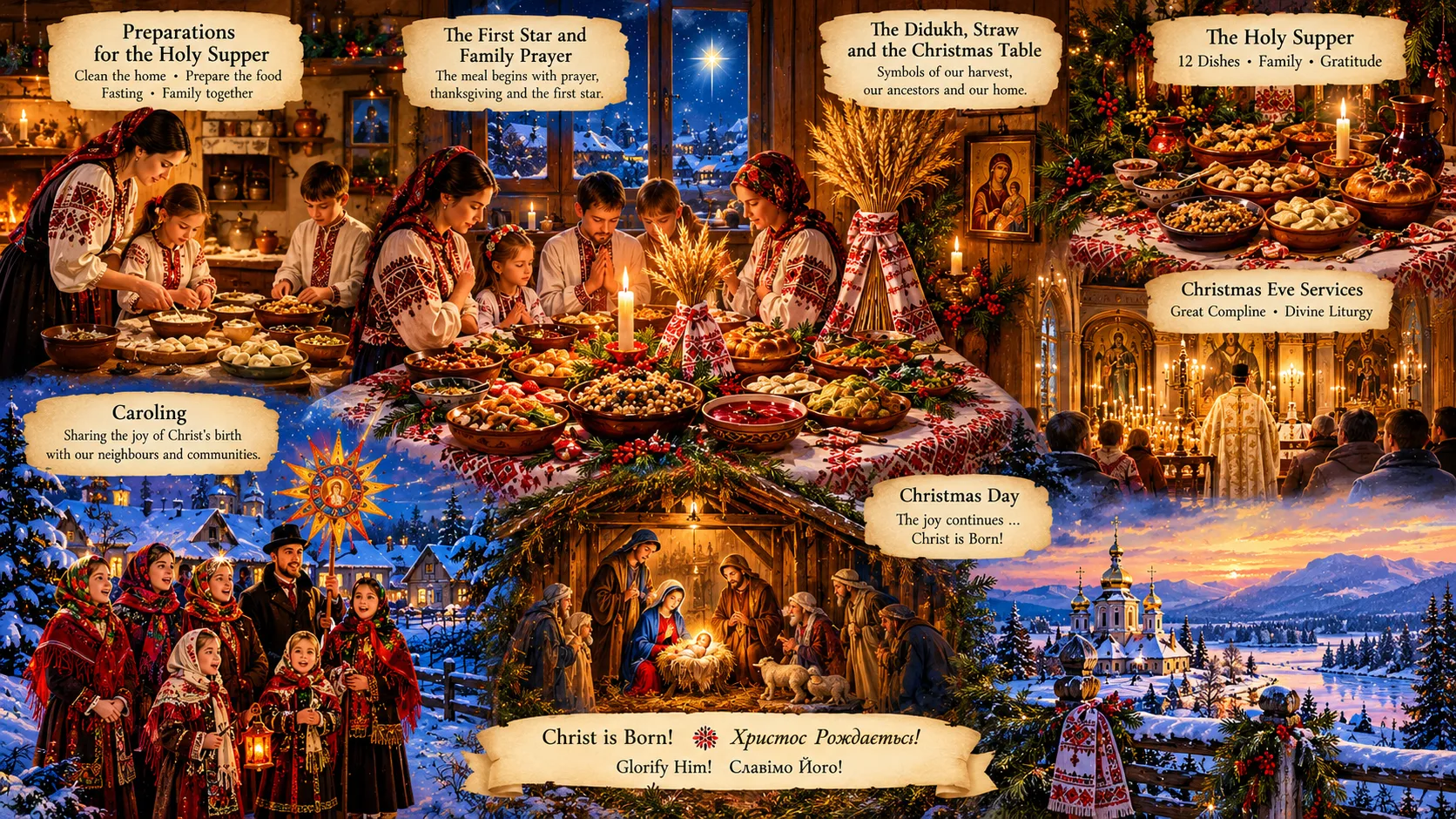
The preparation for Sviatyj Vechir begins well before the evening meal. Families clean and decorate their homes, prepare traditional foods, and make arrangements to gather together.
For many Ukrainians, Christmas Eve is also a day of fasting. The traditional Holy Supper consists of meatless dishes and, according to the customary fast, excludes dairy products and eggs. The fast prepares the faithful spiritually for the celebration of Christ’s birth.
In Ukraine and throughout the Ukrainian diaspora, parents and grandparents often teach children about the meaning of the evening while preparing the meal together. These simple moments in the kitchen become opportunities to pass traditions from one generation to the next.
Whether a family lives in Edmonton, Philadelphia, Warsaw, Zagreb, Munich, London, São Paulo, or Melbourne, the preparations express the same desire: to welcome the newborn Saviour with a grateful heart.
One of the most recognizable Ukrainian Christmas Eve traditions is the preparation of twelve meatless dishes, traditionally associated with the Twelve Apostles.
The menu varies according to regional customs, family recipes, and the ingredients available. Nevertheless, several familiar dishes appear on many Ukrainian Christmas tables:
Kutia is especially important. In many families, it is the first dish served, reminding everyone that this is not an ordinary dinner but a sacred family gathering.
The twelve dishes are traditionally connected with the Twelve Apostles, although some families also associate the number with the twelve months of the year. The exact menu is not universal, and families who cannot prepare twelve dishes can still celebrate the Holy Supper meaningfully.
The purpose is not to impress guests with an elaborate feast. It is to give thanks to God, remember His goodness, and share what we have with those we love.
A particularly beautiful custom is waiting for the first star to appear in the evening sky.
The star recalls the star of Bethlehem that guided the Magi to the newborn Christ. In many households, children eagerly watch the sky and announce when the first star becomes visible. The family then gathers around the table.
A candle may be lit, and the head of the household or another family member leads the opening prayer. The family may pray the Lord’s Prayer, sing the Christmas troparion, or offer prayers for relatives, friends, and those in need.
The meal then begins, often with kutia.
This custom remains meaningful for Ukrainian families around the world. Even when work schedules, city life, or other circumstances make it difficult to wait for the first star, families can preserve the essential practice by beginning the meal with prayer.
The star reminds us that Christmas is not simply a celebration of family traditions. It is the celebration of God’s coming into the world.
The Ukrainian Christmas table is often prepared with special care.
A sheaf of wheat called the didukh (дідух) may be placed in a place of honour in the home. Traditionally associated with the harvest and the memory of previous generations, it is one of the most recognizable symbols of Ukrainian Christmas.
Some families place straw beneath the tablecloth, recalling the manger in Bethlehem where Christ was laid. An embroidered Ukrainian tablecloth, a candle, and traditional bread may complete the setting.
These customs have been preserved in Ukraine and in Ukrainian communities in Canada, the United States, Europe, and Australia. For families living far from their ancestral villages, the didukh and embroidered cloth can be especially meaningful reminders of their roots.
The customs surrounding the didukh and straw are cultural traditions, not requirements of the Church. Their precise meaning and use can differ among regions and families.
What matters most is the truth to which the Christmas table points: the eternal Son of God entered our world in humility and came to dwell among us.
In some Ukrainian households, an extra place is set at the Christmas table.
For certain families, it represents departed relatives who remain lovingly remembered. For others, it expresses readiness to welcome an unexpected visitor or someone who might otherwise spend Christmas Eve alone.
The custom reflects a deeply Christian value: hospitality.
The Holy Family knew poverty and the uncertainty of finding shelter. The Christmas story therefore invites us to make room for others, particularly those who are lonely, displaced, grieving, or struggling.
Ukrainians who have experienced migration and displacement can understand how important it is to find welcome in a new home. Across the diaspora, Christmas Eve can become an opportunity to invite neighbours, friends, newcomers, and those without family nearby to share the meal.
An extra chair at the table may communicate the message of Christmas more clearly than many words: You are welcome here.
For Ukrainian Catholics, the Holy Supper prepares the family for the liturgical celebration of Christ’s Nativity.
Depending on the parish and local schedule, families attend Great Compline, the Divine Liturgy, or other appointed Christmas services. In some places, the celebration takes place late on Christmas Eve; elsewhere, families attend the Divine Liturgy on Christmas morning.
The Church’s worship brings the family celebration into the wider life of the Christian community. The child in the manger is not simply a symbol of family happiness. He is Jesus Christ, the Son of God, who became man for our salvation.
The Holy Supper and the Divine Liturgy therefore belong together. At home, the family prays and shares its meal. In church, the faithful gather to worship the newborn King and celebrate the mystery of the Incarnation.
For Ukrainian Catholics living abroad, the parish also becomes a place where language, liturgical chant, icons, and familiar Christmas greetings connect generations and strengthen their sense of belonging.
After the Holy Supper, many families sing Ukrainian Christmas carols, known as koliadky (колядки).
Carolling is one of the most joyful ways Ukrainian Christmas traditions are shared beyond the home. Groups of children, young people, and adults may visit homes, churches, and community gatherings, singing about the birth of Christ.
In Ukrainian communities in Canada, the United States, Poland, Germany, the United Kingdom, Brazil, Australia, Croatia, and Bosnia and Herzegovina, carolling continues in different forms. Some groups visit homes, while others perform in churches, community halls, schools, and public events.
A Christmas star may accompany the carollers, reminding everyone of the star of Bethlehem. Hosts traditionally welcome the singers with food, refreshments, or donations for charitable causes.
One Ukrainian song that has travelled especially far is Shchedryk, composed and arranged by Mykola Leontovych and known internationally through the English-language adaptation Carol of the Bells. It illustrates how Ukrainian musical heritage can become familiar to people throughout the world while retaining its distinctive origins.
Through carolling, Ukrainians share more than music. They proclaim the good news of Christ’s birth and invite others to rejoice with them.
The Ukrainian diaspora is not one uniform community. Families have settled in many countries, often carrying traditions from particular regions of Ukraine. Over time, those traditions have adapted to local circumstances while preserving their essential character.
In Canada and the United States, Ukrainian Catholic churches, cultural organizations, and family gatherings have helped preserve the Holy Supper, traditional foods, didukh-making, and carolling across generations.
In Poland and Germany, Ukrainian families have continued these customs while living among communities with their own Christmas Eve traditions. Shared foods, family gatherings, and local celebrations can provide points of connection, while kutia and Ukrainian carols preserve a distinctive identity.
In Croatia and Bosnia and Herzegovina, Ukrainian communities have maintained their traditional Christmas meals and customs within a South Slavic cultural setting. Local ingredients, regional histories, and the customs of neighbouring communities can influence how the feast is celebrated.
In the United Kingdom and Australia, Ukrainian families and parishes continue to gather for Christmas worship, prepare traditional foods, and organize carolling and community events. These gatherings help children and grandchildren remain connected to their heritage.
In Brazil and other parts of South America, Ukrainian communities have preserved elements of their cultural and religious identity through churches, family life, traditional cooking, and community celebrations. The local climate and surrounding culture may differ greatly from those of Ukraine, but the meaning of the Holy Supper remains familiar.
Across all these countries, the same central practices appear again and again: prayer, family, a special meal, remembrance, hospitality, and the proclamation of Christ’s birth.
The details may change, but the heart of the tradition travels with the people.
The following comparison summarizes common patterns. It is not intended to suggest that every family in a particular country follows the same customs.
Traditions widely shared among Ukrainian families
Customs that may differ
These differences are a natural part of a living tradition. They need not divide families or communities. Instead, they show how Ukrainian heritage has been carried into different circumstances and passed on in many beautiful ways.
The beauty of the Ukrainian Holy Supper is not found only in the twelve dishes, the didukh, the embroidered tablecloth, or the candle burning on the table. It is found in what these things help us remember.
We remember the humble birth of our Saviour. We give thanks for our families and for those who came before us. We teach our children to pray, to sing, to share, and to welcome others. We preserve the gifts of our ancestors while living faithfully in the places God has called us to serve.
Whether the Holy Supper is celebrated in a Ukrainian village, an Edmonton home, a church hall in London, a family gathering in Zagreb, or a community in Australia or Brazil, its deepest meaning remains the same.
The family gathers in faith. The table is prepared with love. The Church celebrates the mystery of the Incarnation. And the joyful message of Christmas is proclaimed to the world.
May every Ukrainian home, wherever it may be, become a place of prayer, peace, generosity, and hope.
Christ is Born! Христос Рождається!
Glorify Him! Славімо Його!
Святвечір — особливий час для кожної української родини. Це вечір молитви, родинної єдності, вдячності Богові та очікування народження Ісуса Христа.
Де б не жили українці — в Україні, Канаді, Америці, Європі, Бразилії чи Австралії, — вони намагаються зберігати свої різдвяні звичаї та передавати їх наступним поколінням.
Хоча традиції можуть дещо відрізнятися, головне залишається незмінним: родина збирається разом, молиться і радіє народженню нашого Спасителя.
За українським звичаєм, на Святвечір готують дванадцять пісних страв. Вони нагадують про дванадцятьох апостолів. На столі зазвичай є кутя, борщ, вареники, голубці з грибами або рисом, риба, капуста та узвар.
Найважливішою стравою є кутя — варена пшениця з медом і маком. У багатьох родинах саме з неї починають Святу вечерю.
Традиційно родина сідає до столу після появи першої зірки. Вона нагадує про Вифлеємську зорю, яка привела мудреців до новонародженого Ісуса. Перед вечерею всі разом моляться, дякують Богові та згадують рідних.
У деяких домівках під скатертину кладуть сіно, а на почесному місці ставлять дідух — сніп із колосків, який символізує врожай і пам’ять про попередні покоління.
Святвечір — це також час згадати тих, кого вже немає серед нас, помолитися за них і подякувати Богові за наших близьких.
У деяких родинах залишають одне вільне місце за столом. Воно може нагадувати про померлих рідних або бути знаком гостинності для несподіваного гостя чи самотньої людини.
Цей звичай добре передає християнський дух Різдва: ніхто не повинен почуватися забутим або самотнім. Ми покликані ділитися любов’ю, гостинністю та добром.
Для українців-католиків Святвечір є також приготуванням до спільного святкування Різдва в церкві.
Після Святої вечері родини приходять до храму на молитву та різдвяні богослужіння. Саме там ми разом прославляємо Христа, який народився у Вифлеємі заради нашого спасіння.
Родинна молитва вдома і богослужіння в храмі допомагають нам глибше пережити радість цього великого свята.
Жодне українське Різдво важко уявити без колядок.
Діти, молодь і дорослі ходять від хати до хати, співають у церквах та збираються на різдвяні концерти. Через колядки ми розповідаємо світові про народження Ісуса Христа.
Однією з найвідоміших українських мелодій є «Щедрик» Миколи Леонтовича, яка стала відомою в усьому світі як Carol of the Bells.
У багатьох українських громадах колядники також збирають пожертви для потребуючих, військових, поранених та людей, які переживають важкі часи.
Українці зберігають свої різдвяні звичаї в багатьох куточках світу.
У Канаді та Сполучених Штатах парафії й родини продовжують традицію Святої вечері, куті, дідуха та колядування. У Польщі, Німеччині, Хорватії, Боснії і Герцеговині українські родини поєднують власні звичаї з місцевою культурою. У Великій Британії, Австралії та Бразилії українські громади також збираються на молитву, готують традиційні страви й співають рідні колядки.
Не всі святкують однаково. Десь готують усі дванадцять страв, а десь — лише кілька улюблених. Одні родини ставлять дідух, інші зберігають інші прикраси та звичаї. Деякі громади святкують Різдво 25 грудня, інші продовжують дотримуватися юліанського календаря.
Але незалежно від країни, мови чи місцевих звичаїв, українців об’єднують молитва, родина, колядки та радість народження Христа.
Найбільша цінність Святвечора — не в кількості страв чи прикрасах на столі. Вона в тому, що родина збирається разом, молиться, ділиться любов’ю та пам’ятає про Бога.
Для українців, які живуть далеко від Батьківщини, ці звичаї допомагають зберігати зв’язок із рідною землею, своїми предками та наступними поколіннями.
Нехай кожна українська родина, де б вона не жила, матиме у своєму домі мир, любов, молитву та надію.
Христос Рождається! Славімо Його!
