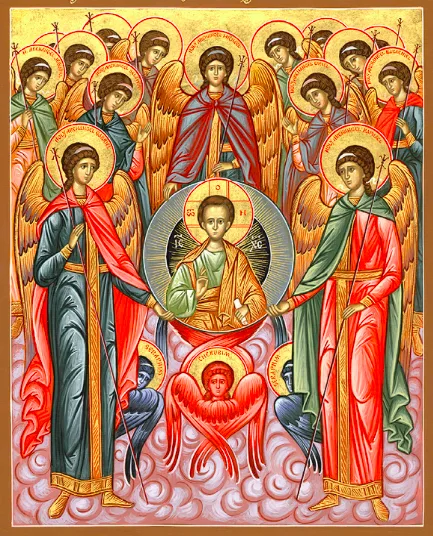
The Synaxis of the Archangel Michael and the Other Bodiless Powers is celebrated on November 8 in the Byzantine Catholic and Eastern Orthodox Churches.
The word synaxis means “assembly” — a gathering of the faithful to honor Saint Michael the Archangel and all the heavenly hosts who serve God in His divine plan of salvation.
The feast grew out of the ancient Eastern liturgical tradition, connected to the dedication of early churches to Saint Michael, such as the Michaelion near Constantinople and the basilica on the Salarian Way near Rome.
While the “Eighth Day” of the month beautifully symbolizes eternity and the fullness of creation in Christ, the feast’s true historical roots lie in these early dedications and the Byzantine calendar.
🕊️ The Council of Laodicea (4th century) did not institute this feast.
Its canon warned against a kind of “covert idolatry” involving angels.
The Church’s proper veneration of the angels developed later in a sound, liturgical context.
The Church teaches that worship (latria) belongs to God alone, while veneration (hyperdulia) is the special honor given to the saints and angels.
The Directory on Popular Piety and the Liturgy affirms that the Church “venerates the angels who help her on her earthly pilgrimage.”
The Catechism of the Council of Trent likewise teaches that this veneration is not contrary to the First Commandment, for all honor given to angels glorifies God, their Creator.
“The honor we pay the angelic creatures redounds to Your own surpassing glory.”
— Roman Missal, Feast of the Archangels
Sacred Scripture presents the angels as messengers and protectors:
“Are they not all ministering spirits sent forth to serve, for the sake of those who are to obtain salvation?”
— Hebrews 1:14
The Second Council of Nicaea (787) explicitly approved the veneration of “the honourable Angels” along with Christ, the Mother of God, and the saints.
Thus, in the liturgy, the Church joins the angels in praising the Lord, while they unite their praise with ours before the heavenly throne.
The Pseudo-Dionysian tradition speaks of nine choirs of angels — Seraphim, Cherubim, Thrones, Dominions, Virtues, Powers, Principalities, Archangels, and Angels.
This hierarchy is not a ranking of worship but a theological meditation on God’s creative order.
The angels are spiritual (non-corporeal) beings — personal, intelligent, and entirely devoted to the will of God.
They are not “ghosts,” but radiant spirits of love and obedience.
On this day, heaven and earth unite in one hymn of praise.
Saint Michael — whose name means “Who is like God?” — leads the angelic hosts in defending the Church and guiding the faithful toward the Kingdom.
The feast reminds us that the visible and invisible worlds are united in one worship of the Holy Trinity, and that every believer is accompanied by the protection of the heavenly powers.
Orthodox (Byzantine) – Celebrated on 8 November
Latin-rite Catholic – Principal feast of Michaelmas on 29 September, honoring Michael, Gabriel, and Raphael.
Eastern-Catholic (UGCC) – Observed on 8 November .
🗓️ Old-Calendar Orthodox: 21 Nov civilly | Eastern-Catholic: 8 Nov civilly
The difference can cause confusion in shared events, so calendars should be specified clearly.
Byzantine Title: Synaxis of the Archangel Michael and All the Bodiless Powers — emphasizes the whole angelic host gathered in divine worship.
Latin Title: Feast of the Archangels or Michaelmas — emphasizes Michael’s personal mission as protector and defender.
The Byzantine title stresses the communal unity of heaven’s choirs;
the Latin title highlights Michael’s guardianship and intercession.
Eastern Tradition: Celebrates a theological progression —
29 Sept (Archangels) → 2 Oct (Guardian Angels) → 8 Nov (Synaxis of all).
Latin Tradition: Celebrates 29 Sept (Archangels) and 2 Oct (Guardian Angels), with no distinct 8 November synaxis.
Understanding these rhythms prevents confusion or overlap in shared devotion.
Eastern Tradition: Traces the 8 November date to dedications of churches to St Michael — especially near Constantinople and on the Salarian Way in Rome.
Western Tradition: Connects 29 September to the Apparition of St Michael on Mount Gargano and to medieval Michaelmas customs.
Both traditions are ancient and legitimate, each rooted in its own local devotion.
Old-Calendar Orthodox: 8 November Gregorian= 21 November Julian
New-Calendar Orthodox and all Eastern-Catholics: 8 November Gregorian.
Always note which calendar is used to avoid scheduling errors.
Eastern Texts: Emphasize Michael as Archistrategos (chief commander) of the heavenly hosts and the cosmic unity of the angelic worship.
Western Texts: Emphasize Michael as protector of the Church and guardian of the faithful, especially in the Guardian Angel devotion.
Each expresses a unique but complementary vision of the angelic ministry in salvation history.
When teaching or publishing about the Feast of St Michael:
✅ Clearly state the calendar (Julian vs. Gregorian).
✅ Respect the different titles (Synaxis vs. Feast of the Archangels).
✅ Acknowledge each tradition’s sequence of feasts and local history.
✅ Use the proper term veneration (hyperdulia), not worship, for the angels.
By doing so, we affirm the shared faith in God’s angelic messengers while honoring the liturgical richness of East and West.
O Holy Archangel Michael,
Defender of the Church and protector of souls,
guard us against every evil, guide our steps in truth,
and help us to join the angels and saints
in the eternal praise of God.
Through Christ our Lord. Amen.