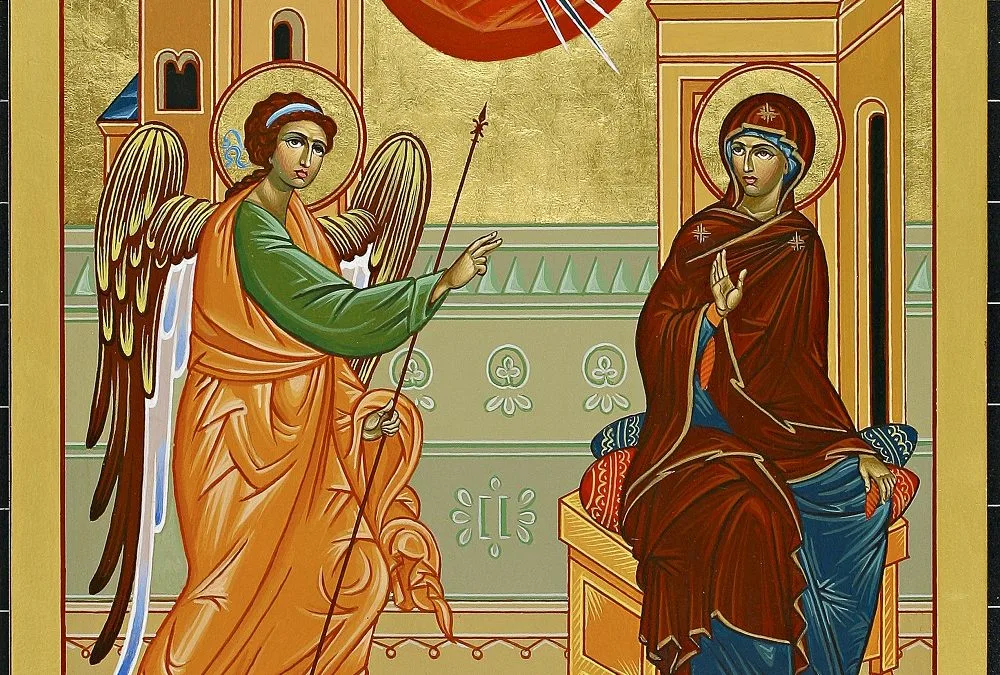
The Feast of the Annunciation is one of the most important liturgical celebrations in the Christian Church, both in the Eastern and Western traditions. It commemorates the moment when the Archangel Gabriel announced to the Virgin Mary that she had been chosen by God to be the Mother of Jesus Christ, the Son of God. This feast is celebrated on March 25, exactly nine months before Christmas, highlighting its connection to the Incarnation.
Here’s a detailed description with history and theological significance according to Church teaching:
The feast is rooted in the Gospel of Luke:
“In the sixth month, the angel Gabriel was sent from God to a city of Galilee named Nazareth, to a virgin betrothed to a man named Joseph; and the virgin’s name was Mary. And the angel came to her and said, ‘Greetings, O favored one, the Lord is with you!’” (Luke 1:26–28)
Gabriel announces that Mary will conceive by the Holy Spirit and bear the Son of God. Mary’s “Fiat” (Let it be done) is her free acceptance of God’s will, marking her as Theotokos (“God-bearer”), a title confirmed by the Council of Ephesus in 431.
Early Commemoration:
The feast appears in Christian liturgical calendars by the 4th–5th century, first in the East, possibly connected to the dedication of churches in honor of the Annunciation in Nazareth.
The West adopted it later; by the 7th–8th centuries, it was celebrated universally in Rome.
Liturgical Placement:
In the Eastern Church (UGCC, Orthodox), the feast is ranked as one of the Great Feasts, immediately after Pascha (Easter) in importance. It includes Vespers, Matins, and Divine Liturgy, often with hymns emphasizing Mary’s role and the mystery of the Incarnation.
In the Western Church (Roman Catholic), it is a solemnity, sometimes adjusted if it falls during Holy Week, reflecting its high importance.
Connection with Incarnation Doctrine:
The feast is not merely about Mary but about God becoming man. It celebrates the hypostatic union, the teaching that Jesus is fully God and fully man from the moment of conception.
Mary is venerated as the New Eve, whose obedience contrasts with the disobedience of the first Eve, and whose role in salvation history is essential.
Incarnation and Salvation:
The Annunciation celebrates God entering human history. Through Mary’s consent, the Word becomes flesh (John 1:14).
It is a feast of joy and hope, emphasizing divine initiative and human cooperation.
Mary as Model of Faith:
Her “Fiat” shows total trust in God, making her a model for all Christians.
The Church teaches her perpetual virginity, sinlessness (especially in Catholic doctrine through the Immaculate Conception, proclaimed in 1854 by Pope Pius IX), and unique role in redemption.
Liturgical Observances:
Hymns highlight both Mary’s humility and the angelic greeting.
The Eastern Church sings Akathists and troparia focused on the Annunciation, while the Western Church emphasizes the Angelus prayer and Marian devotion.
Council of Ephesus (431): Declared Mary Theotokos, affirming that Christ is one Person, fully divine and fully human. The Annunciation is the historical moment this doctrine begins in time.
Catechism of the Catholic Church (CCC 484): “The angel Gabriel was sent to Mary, a virgin betrothed to Joseph, to announce the coming of the Savior. By her ‘yes,’ she conceived the Son of God in her womb.”
Eastern Theology: The feast celebrates the mystery of God taking flesh without ceasing to be God, a moment essential for all salvation.
The Feast of the Annunciation is the Church’s celebration of the moment of the Incarnation, when God became man through Mary’s willing cooperation. It honors Mary as the Mother of God, highlights the mystery of salvation, and invites the faithful to emulate her faithful obedience. It is both a historical and theological celebration, connecting biblical events, dogmatic teaching, and liturgical devotion.
Благовіщення – це день, коли Архангел Гавриїл сповістив Пресвяту Діву Марію, що Вона обрана Стати Матір’ю Сина Божого, Ісуса Христа. Це момент Втілення Слова Божого в людську природу.
Свято відзначається 25 березня, тобто рівно за дев’ять місяців до Різдва Христового, підкреслюючи логічний і символічний зв’язок народження Спасителя та Його зачаття.
Основний текст – Євангеліє від Луки:
«У шостому місяці ангел Гавриїл був посланий Богом до міста Галілеї, що зветься Назарет, до діви, обрученої чоловікові на ім’я Йосиф, а дівчина зветься Марія. І ввійшовши до неї, сказав: Радуйся, Благодатна, Господь з Тобою!» (Лк 1:26–28)
Гавриїл оголошує, що Марія зачне Духа Святого і народить Сина Божого. Її «Нехай буде мені за словом твоїм»(Fiat) – це акт добровільної віри та послуху, який робить Марію Богородицею (Theotokos), що було підтверджено Ефеським собором (431 р.).
Ранні згадки
Свято з’являється у християнських календарях уже у IV–V ст., спершу на Сході, особливо пов’язане з храмами у Назареті, де відбулося Благовіщення.
На Заході свято стало поширеним у VII–VIII ст., і поступово отримало статус урочистості.
Літургійне місце в УГКЦ
УГКЦ відзначає Благовіщення як велике свято з обов’язковою Літургією та Вечірнею.
Головна тема – втілення Слова Божого та співпраця Марії у плані спасіння світу.
На Сході свято часто поєднується із піснеспівами: тропар, кондак, величання Богородиці.
Догматичне значення
Благовіщення підкреслює доктрину Втілення Сина Божого, коли Христос стає повністю Богом і повністю людиною.
Марія зображується як Нова Єва, послух якої відновлює людство після падіння.
Втілення та спасіння
Свято наголошує на божественній ініціативі та людській співпраці у плані спасіння.
Христос від першого моменту зачаття є Богом і Людиною одночасно.
Марія – взірець віри
Її «Нехай буде мені за словом твоїм» є прикладом довіри Богові.
Церква вчить про непорочне зачаття та вічне дівоцтво Марії.
Літургійне святкування
УГКЦ під час Благовіщення співає тропар, кондак, величання, особливо в контексті Великого посту, коли свято може припадати на період посту.
Вірні часто моляться Акафіст до Пресвятої Богородиці, Angelus (на Заході) або особисті молитовні практики на честь Богородиці.
Ефеський собор (431): підтвердив, що Марія – Богородиця, бо Христос є єдиною особою з двома природами – божественною і людською.
Катехизм УГКЦ / Катехизм Католицької Церкви (484): Марія добровільно прийняла Божий план, ставши співтворцем спасіння людства.
Східне богослов’я: свято відображає таїнство Втілення, коли Бог стає людиною через Марію, не втрачаючи Божества.
Благовіщення – це свято радості та надії, що прославляє Марію як Матір Божу і підкреслює істину Втілення Христа. Воно поєднує біблійну історію, догматичну істину та літургійну практику, запрошуючи віруючих до наслідування віри та послуху Богові.