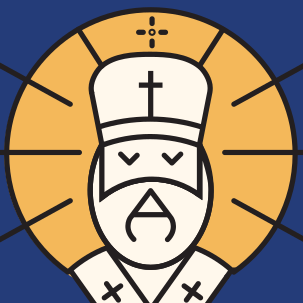
On June 24, the Church celebrates something very rare.
It does not celebrate the death of a saint.
It celebrates a birth.
The birth of
John the Baptist.
And not just any birth—but the birth of the one who prepares the way for Jesus Christ.
Many people know his name, but not his story.
John is the one who stands at the edge of the Gospel.
He does not yet announce Jesus directly at the beginning of the story—but he prepares everything so that people are ready to receive Him.
That is why the Church calls him:
👉 The Forerunner
👉 The Voice in the wilderness
👉 The one who prepares the way
He is like someone standing at the door, saying:
“Get ready. Someone important is coming.”
John’s parents were elderly and had no children.
His father was a priest named
Zechariah.
While he was serving in the Temple in Jerusalem, something extraordinary happened:
An angel appeared and told him:
“Your wife will have a son.”
Zechariah did not believe it.
And because of his doubt, he became unable to speak.
From that moment, he lived in silence.
Not as punishment alone—but as preparation.
Sometimes God prepares people in silence before He reveals something great.
When the child was born, everyone expected him to be named after his father.
But his mother said:
“No. His name is John.”
When Zechariah confirmed this in writing, something incredible happened:
His voice returned.
And the first thing he did was bless God.
From silence came praise.
John grew up in the wilderness.
He lived simply.
He preached a simple message:
👉 Turn back to God
👉 Change your heart
👉 Prepare for the Lord
People came from all around to hear him.
Some even thought he might be the Messiah.
But John always said clearly:
“No. I am not the one you are waiting for.”
And then he pointed to Jesus and said:
“Behold the Lamb of God.”
That is the center of his entire life.
He does not draw attention to himself.
He points to Christ.
Most saints are remembered on the day they died.
But the Church celebrates John’s birth because his life is deeply connected to Jesus from the very beginning.
The Gospel tells us something important:
When Mary was expecting Jesus, she visited Elizabeth, who was expecting John.
At that moment, John “leaped” in his mother’s womb.
The Church sees this as a sign:
👉 Even before birth, John already recognizes Jesus.
His whole life is already turned toward Christ.
John’s feast is celebrated on June 24, close to the longest days of light in the year.
After that day, daylight slowly begins to decrease.
Then comes Christmas in winter—when days begin to grow longer again.
Christians have long reflected on this pattern.
It connects beautifully to John’s own words:
“He must increase, and I must decrease.”
This is not a scientific rule.
It is a spiritual reflection.
A way of saying:
👉 John prepares the way
👉 Jesus is the true Light
The Gospel is very clear that John’s story is not a legend.
It takes place in real places:
This reminds us that our faith is not based on ideas alone.
It is based on God entering real human history.
The Nativity of Saint John the Baptist is not only about him.
It is also about us.
Because John’s message is still the same:
👉 Prepare your heart
👉 Turn back to God
👉 Make space for Christ
And maybe the simplest lesson is this:
John shows us how to live a life that is not centered on ourselves.
A life that points beyond us.
A life that says:
“It is not about me. It is about Christ.”
John’s birth is like the first light before sunrise.
Not the sun itself.
But the sign that the sun is coming.
And so the Church celebrates him with joy.
Because every time we remember John the Baptist, we are reminded of this truth:
Christ is coming.
Christ is near.
And our lives are meant to prepare the way.
Each year the Latin Church celebrates the Solemnity of the Most Sacred Heart of Jesus, a feast that invites the faithful to contemplate the love of Christ revealed in His saving sacrifice. For many Eastern Catholics, especially those formed within the Byzantine tradition, this solemnity raises an interesting question: How does devotion to the Sacred Heart relate to the spiritual and liturgical life of the Christian East?
The answer begins with an important principle of Catholic faith.
The Church proclaims one Gospel, one Lord, one faith, and one baptism. Yet throughout history that one faith has been expressed through a variety of liturgical, theological, and spiritual traditions. The Ukrainian Greek Catholic Church teaches that the Gospel becomes clothed in the mentality, culture, and history of different peoples. As a result, distinct traditions develop while remaining faithful to the same apostolic faith.
For this reason, Eastern and Western Christians need not approach one another’s traditions as rivals or competitors. Rather, they may recognize in them different expressions of the same saving mystery.
One of the most beloved titles for Christ in the Christian East is “Lover of Mankind” (Philanthropos).
The term reflects the biblical revelation of God’s loving kindness toward humanity and expresses a central conviction of Eastern Christian spirituality: that the entire work of salvation flows from God’s love for His creation.
The mystery of Christ’s Incarnation, His voluntary Passion, His Death upon the Cross, His glorious Resurrection, and His Ascension are all understood as manifestations of divine love. God does not abandon fallen humanity but enters human history in order to restore, heal, and unite humanity to Himself.
Eastern theology often contemplates salvation in terms of participation in divine life. The Fathers of the Church spoke of this mystery as theosis, humanity’s communion with God through Christ and in the Holy Spirit.
Thus, when Eastern Christians reflect upon Christ as the Lover of Mankind, they are contemplating not merely a single attribute of Christ but the entire economy of salvation through which God’s love is revealed to the world.
The Solemnity of the Most Sacred Heart of Jesus developed within the spiritual and liturgical life of the Western Church as a particular way of contemplating the love of Christ.
The devotion is centered upon the person of Jesus Christ Himself. The Heart of Christ is venerated not as an isolated physical reality but as a symbol of the love with which the incarnate Son of God loves His Father and all humanity.
Pope Pius XII taught that devotion to the Sacred Heart is firmly rooted in Sacred Scripture, Sacred Tradition, and the liturgical life of the Church. He rejected the notion that it should be viewed merely as a private devotion detached from the Church’s worship. Instead, he described it as a devotion that grew organically within the life of the Church from contemplation of Christ and His saving love.
For this reason, the Sacred Heart occupies an important place within Catholic spirituality. It directs believers toward the mystery of the Incarnation, the saving Passion of Christ, and the inexhaustible mercy of God revealed through Him.
When comparing Eastern and Western approaches, care must be taken not to create unnecessary contrasts.
The Christian East possesses a profound theology of divine mercy, sacrificial love, repentance, healing, and communion with God. Likewise, the Christian West contemplates the fullness of Christ’s saving work and humanity’s participation in divine life.
The difference lies primarily in emphasis and expression.
The Byzantine tradition tends to express the mystery of God’s love through its liturgical prayer, sacramental life, iconography, ascetical practice, and theology of salvation.
The Latin tradition often expresses that same mystery through devotion to the Sacred Heart, contemplating Christ’s love as revealed through His humanity, His wounds, His sacrifice, and His mercy.
Neither approach exhausts the mystery. Both seek to lead believers toward deeper communion with Jesus Christ.
A particularly important point of convergence is found in the Church’s worship.
The Byzantine Divine Liturgy presents the entire history of salvation and gives thanks for all that God has accomplished for humanity through Christ. Through the Eucharistic celebration, believers participate in the saving mystery of Christ and receive the sanctifying grace of the Holy Spirit.
Similarly, devotion to the Sacred Heart is inseparable from the Church’s liturgical and sacramental life. It is not merely an individual or emotional practice but a Christ-centered devotion rooted in the Church’s worship and faith.
Both traditions therefore direct the faithful toward the living Christ who continues to sanctify His people through the life of the Church.
Eastern Catholics need not regard the Solemnity of the Sacred Heart as foreign to the Catholic faith. At the same time, they need not abandon their own theological and liturgical heritage in order to appreciate it.
The Sacred Heart may be understood as a distinctly Western expression of the Church’s contemplation of Christ’s saving love. Eastern Christians encounter that same love through the language of the Divine Liturgy, the feasts of the Church, the Holy Mysteries, the witness of the Fathers, and the rich theological vision of the Christian East.
These traditions do not compete with one another. Rather, they enrich the Church by offering different perspectives on the inexhaustible mystery of Jesus Christ.
The Solemnity of the Most Sacred Heart of Jesus and the Byzantine contemplation of Christ as the Lover of Mankind both direct the faithful toward the same Lord.
Both proclaim that salvation begins with God’s love.
Both point to the mystery of the Incarnation and the saving work of Christ.
Both invite believers into deeper communion with God.
In a world often marked by division, suffering, and uncertainty, both traditions bear witness to the central truth of the Gospel: that God so loved the world that He gave His only Son, so that all who believe in Him might have eternal life.
Whether contemplated through the language of the Sacred Heart or through the Byzantine vision of Christ the Lover of Mankind, the Church ultimately proclaims the same saving message—the immeasurable love of God revealed in Jesus Christ.
Fort Saskatchewan Care Community is a beautiful new supportive living community in a prime location in Fort Saskatchewan, within walking distance to The SouthPoint Shopping Centre and many restaurants, shops, and activities.
Our community is dedicated to the Eden Alternative model of care, which promotes maximum independence, choice, and dignity for each resident and encourages the involvement of family, neighbors, and friends. Residents bring their own belongings including furniture, and may keep their small pets in their suites.
Opened in Fall 2023, Fort Saskatchewan Care Community is modern and attractive, and geared to residents’ comfort and enjoyment
https://fortsaskatchewancarecommunity.com/
Join us for a special Divine Liturgy at Southfort Bend Gardens Lodge, designed to uplift and bring together seniors in our community. This beautiful event offers an opportunity for residents and their families to participate in a cherished tradition of the Ukrainian Catholic Church, fostering a sense of connection, faith, and community.
The Divine Liturgy at Southfort Bend Gardens Lodge provides a welcoming environment where seniors can engage in worship and spiritual reflection. As we gather in prayer, we create a supportive atmosphere that enhances the well-being of our elderly parishioners. This gathering is especially meaningful for those who may find it challenging to attend regular services at the church due to mobility or health concerns.
The Divine Liturgy is more than just a religious service; it’s an opportunity for seniors to come together in faith and fellowship. Sharing this sacred experience strengthens the bonds of friendship and support among residents, promoting mental and emotional well-being.
Additionally, family members are encouraged to attend, fostering intergenerational connections that enrich the lives of both seniors and their loved ones.
The Divine Liturgy at Southfort Bend Gardens Lodge provides an invaluable spiritual experience for seniors in our community. It serves as a reminder of God’s love, offering hope and connection through faith. Join us for this enriching service as we gather in prayer, support one another, and strengthen our bonds as a community of faith.
Divine Liturgy at Ottewell Place Lodge with Seniors
Join us for the Divine Liturgy at Ottewell Place Lodge, a special gathering with our senior residents. This cherished service in the Ukrainian Catholic tradition offers prayer, reflection, and a sense of community, bringing comfort and spiritual nourishment to everyone present.
Family members and friends are warmly invited to share in this meaningful time of worship and fellowship.
Divine Liturgy at AgeCare Miller Crossing @ 2 pm
Join us for the Divine Liturgy at AgeCare Miller Crossing, a special time of prayer and worship in the Ukrainian Catholic tradition. This sacred service brings Christ’s presence into the lives of our seniors, offering comfort, strength, and a sense of community.
Family members and friends are warmly welcome to attend and share in this uplifting experience of faith and fellowship.
14251 50 Street NW, Edmonton, Alberta, T5A 5J4
Divine Liturgy at Millennium Pavilion Lodge
Come join us for the Divine Liturgy at Millennium Pavilion Lodge, a sacred celebration in the Ukrainian Catholic tradition. This special gathering offers our seniors the gift of prayer, comfort, and connection with Christ and with one another.
Families and friends are encouraged to attend and share in this meaningful time of worship and fellowship.
Divine Liturgy at the Lodge with seniors starting usually at 10 AM
Divine Liturgy at Dr. Turner Lodge
Join us at Dr. Turner Lodge for the Divine Liturgy, a cherished opportunity for seniors to gather in prayer and reflect on their faith. This special service in the Ukrainian Catholic tradition brings spiritual comfort, community, and a sense of peace to all who attend.
Residents, families, and friends are warmly invited to participate and share in this uplifting experience of worship and fellowship.
“I am the living bread which came down from heaven; if anyone eats of this bread, he will live forever.” (John 6:51)
Among all the feasts celebrated by the Catholic Church, few direct our attention so clearly to the very heart of Christian life as the Feast of the Holy Eucharist, commonly known in the Latin tradition as Corpus Christi (“The Body of Christ”). This feast is a joyful proclamation of one of the greatest mysteries of our faith: that Jesus Christ is truly, really, and substantially contained in the Holy Eucharist. Under the species of bread and wine, Christ Himself is present—Body, Blood, Soul, and Divinity.
For Catholics, the Eucharist is not merely a symbol, a reminder, or a sacred meal. The Eucharist is Christ Himself, given for the life of the world.
The origins of the Eucharist are found in the words and actions of Jesus Himself at the Last Supper.
On the night before His Passion, our Lord took bread, blessed it, broke it, and gave it to His disciples saying:
“Take, eat; this is My Body.”
Then He took the chalice and said:
“Drink of it, all of you; for this is My Blood of the New Covenant, which is shed for many for the forgiveness of sins.” (Matthew 26:26–28)
These words are not merely symbolic language. The Church has always understood them as Christ’s institution of the Eucharist. From the beginning, the celebration of the Eucharist has been inseparably connected to the Church’s apostolic ministry through which Christ continues to nourish His people.
At every Divine Liturgy and Mass, Christ’s command is fulfilled:
“Do this in memory of Me.” (Luke 22:19)
The Eucharist is therefore not a new sacrifice, but the sacramental participation in the one saving sacrifice of Christ on Calvary.
From the earliest centuries, Christians believed in the Real Presence of Christ in the Eucharist. The Fathers of the Church, both East and West, consistently taught that the bread and wine become the Body and Blood of Christ through the action of the Holy Spirit.
During the Middle Ages, various errors arose that questioned or denied Christ’s Eucharistic presence. At the same time, Saint Juliana of Liège promoted the idea of a special feast dedicated to the Holy Eucharist. After careful consideration, Pope Urban IV established the Feast of Corpus Christi for the entire Latin Church in 1264.
The feast was intended as a joyful public profession of faith in Christ’s Eucharistic presence.
Although the liturgical feast of Corpus Christi developed within the Latin Church, the Eucharistic faith it celebrates belongs equally to East and West.
In the Byzantine tradition, the Holy Eucharist stands at the center of the Church’s life and worship. At every Divine Liturgy, the faithful are invited:
“Receive the Body of Christ; taste the Fountain of Immortality.”
Eastern Catholics express their faith in Christ’s Eucharistic presence through the Divine Liturgy, the reception of Holy Communion, Eucharistic devotion, and the rich liturgical life of the Church. The West developed additional public expressions such as Corpus Christi processions and Eucharistic adoration, but the faith professed is the same.
As Saint John Paul II beautifully observed:
“The Church makes the Eucharist, but the Eucharist makes the Church.”
The Church teaches that through the consecration at the Divine Liturgy and Mass, the bread and wine become the true Body and Blood of Christ.
This change is called Transubstantiation in Catholic theology.
While the outward properties of bread and wine remain, their substance is changed by the power of God into the Body and Blood of Christ. Therefore Christ is truly, really, and substantially present under the Eucharistic species.
This presence remains as long as the Eucharistic species remain. For this reason, the Eucharist is reserved in the tabernacle, carried to the sick, and treated with the greatest reverence and love.
The Eucharist is inseparably united to Christ’s sacrifice on the Cross.
The Divine Liturgy and the Mass do not repeat Calvary, nor is Christ sacrificed again. Rather, the Church enters into the living remembrance (anamnesis) of Christ’s saving death and Resurrection. The one sacrifice of Christ, offered once for all, is made present to the faithful so that every generation may participate in its saving grace.
In this mystery, heaven and earth meet, and believers are drawn into Christ’s self-offering to the Father.
The Byzantine tradition often refers to the Holy Eucharist as the “Medicine of Immortality” and the “Fountain of Life.”
Before receiving Holy Communion, the faithful proclaim their faith in Christ and prepare their hearts to receive Him worthily. The Eucharist strengthens our union with Christ, deepens charity, helps to remit venial sins, strengthens us against temptation, and unites us more closely to the Church.
Through this sacrament, Christ heals, nourishes, and strengthens His people for the journey of faith.
One of the most recognizable customs associated with Corpus Christi is the Eucharistic procession.
The Blessed Sacrament is carried publicly through streets, neighborhoods, and communities while the faithful pray and sing hymns of praise. Such processions are a public witness that Christ remains present among His people and accompanies them on their pilgrimage toward the Kingdom of God.
In a world often marked by distraction, division, and uncertainty, the Feast of Corpus Christi calls us back to the center of our faith.
Christ has not left His people alone.
He remains with us.
He feeds us with His very life.
He accompanies us on our earthly pilgrimage.
Whether celebrated in the Divine Liturgy, in Eucharistic adoration, in a Corpus Christi procession, or in silent prayer before the tabernacle, this feast invites every believer to renew faith in the words of our Lord:
“He who eats My Flesh and drinks My Blood abides in Me, and I in him.” (John 6:56)
May our love for the Holy Eucharist grow ever deeper, and may we always approach this great mystery with faith, reverence, gratitude, and joy.
“Receive the Body of Christ; taste the Fountain of Immortality.”
Join us every Wednesday for the Weekly Divine Liturgy at our parish, a beautiful opportunity for worship, reflection, and community bonding in the heart of our spiritual life. This midweek service allows our congregation to come together to deepen our faith, find solace in prayer, and connect.
The Divine Liturgy is the central act of worship in the Ukrainian Catholic tradition. It is a sacred celebration where we gather as a community to honour and remember the life, death, and resurrection of Jesus Christ. During this service, we participate in the Holy Eucharist, which is the foundation of our faith and a source of spiritual nourishment.
Wednesdays are particularly special, offering a pause in the week for spiritual renewal and connection with God. Whether you are a longtime member of our parish or a newcomer seeking a spiritual home, you are warmly invited to join us for this uplifting experience.
Our Weekly Divine Liturgy on Wednesdays is designed to be accessible and welcoming for everyone, including families and individuals of all ages. We encourage parents to bring their children, as this is a wonderful opportunity to instill the values of faith and community from a young age.
The atmosphere during the Divine Liturgy is warm and inviting, creating a sense of belonging for all attendees. We strive to make every participant feel at home, allowing them to engage fully in the worship experience.
We invite you to make the Weekly Divine Liturgy on Wednesdays a part of your spiritual journey.
This midweek gathering offers a unique chance to recharge spiritually, reflect on the Word of God, and connect with fellow parishioners. Through prayer, music, and shared faith, we can support one another in our journeys of faith.