Monday, October 26, 2026
“The word of God is not chained.” — 2 Timothy 2:9
Imagine being told that you must stop speaking about Jesus. Imagine being thrown into prison simply because you believe in Him. Would you still have the courage to stand up for your faith?
More than 1,700 years ago, a Christian named Demetrius faced this very choice. He chose Christ, even when it cost him his life. Today, the Ukrainian Catholic Church honours him as the Holy and Glorious Great-Martyr Demetrius, the Myrrh-Streamer.
His feast is celebrated on Monday, October 26, with an All-Night Vigil rank. The faithful are highly encouraged to participate in the Divine Liturgy and give thanks to God for the life and witness of this beloved saint.
But Saint Demetrius’s story is more than a story about a brave man from long ago. It is a story about courage, friendship, faith, and a mystery that attracted pilgrims from far away.
Saint Demetrius lived in Thessalonica, an important city in the Roman Empire, in the late third and early fourth centuries. The city is still called Thessaloniki today and is located in northern Greece.
According to Church tradition, Demetrius came from a distinguished family and held an important position in society. He was educated, respected, and influential. Yet he understood that no earthly honour was greater than belonging to Jesus Christ.
At that time, Christians could be persecuted for refusing to worship the Roman gods. Demetrius openly professed his faith and encouraged others to follow Christ.
This eventually led to his arrest and imprisonment. Traditional accounts place his martyrdom around the year 306, during the persecutions associated with the Roman emperor Galerius Maximian.
A fascinating fact: Saint Demetrius is especially connected with Thessalonica, where a magnificent church was built in his honour. For centuries, Christians have regarded him as the heavenly protector of the city.
Today, his feast is celebrated throughout the Byzantine Christian world, including in our Ukrainian Catholic Church.
One of the most exciting stories associated with Saint Demetrius involves a young Christian named Nestor and a powerful fighter named Lyaeus.
According to the traditional account, Lyaeus was known for defeating his opponents in public contests. The emperor’s games made him a symbol of strength and victory.
Nestor, a young man who knew Demetrius, wanted to face this fighter. Before entering the contest, he went to the imprisoned Demetrius and asked for his blessing.
Demetrius encouraged him. Trusting in God’s help, Nestor confronted Lyaeus and defeated him.
The emperor was furious. Nestor was sentenced to death, and Demetrius was also ordered to be killed.
The Church commemorates Saint Nestor on October 27, the day after Saint Demetrius.
This story is remembered in the troparion sung for Saint Demetrius:
“As you smashed the pride of Lyaeus, encouraging Nestor to struggle, pray to Christ our God to grant great mercy to our souls.”
Notice something important: the hymn does not simply celebrate a physical victory. It remembers Demetrius as someone who encouraged another person to be courageous.
For children to think about: Have you ever been afraid to do the right thing because you thought others might laugh at you? Have you ever needed a friend to encourage you?
Sometimes, being a good Christian means being the friend who says, “Don’t give up. Do what is right. God is with you.”
Of course, Christian courage is not about hurting others or proving that we are stronger. It is about choosing what is right, even when it is difficult.
Here is one of the most unusual parts of Saint Demetrius’s story!
The word myrrh refers to a fragrant substance associated with perfume, anointing, and burial in the ancient world. The name Myrrh-Streamer comes from the Christian tradition that fragrant myrrh flowed from the area of the saint’s tomb and his holy relics.
In Greek, he is called Myrovlitis, meaning “the one who streams myrrh.”
After his death, Christians honoured Demetrius at his burial place in Thessalonica. Over time, a church was built there, and the faithful came to pray and seek his intercession. Reports of fragrant myrrh became an important part of his veneration.
The great Basilica of Saint Demetrius in Thessalonica remains a historic centre of devotion to the saint. The church was severely damaged by a great fire in 1917 and later restored.
Did you know? The ancient city of Thessalonica was an important place in the Bible, too! Saint Paul visited the city and wrote two letters to the Thessalonians, which are included in the New Testament.
The city that heard the preaching of Saint Paul later became famous throughout the Christian world for its devotion to Saint Demetrius.
What a beautiful connection: the Gospel was preached in Thessalonica, Christians continued to live their faith there, and the memory of a faithful martyr has been preserved for centuries.
The tradition of myrrh also invites us to consider a deeper spiritual question. What fragrance does our own life leave behind?
Saint Paul writes that Christians are called to be “the aroma of Christ” (2 Corinthians 2:15).
We may not leave a physical fragrance behind us, but we can leave the fragrance of kindness, forgiveness, generosity, and love. People may remember us because we helped them when they were lonely, forgave them when they made a mistake, or encouraged them when they felt discouraged.
That is a beautiful way to honour Saint Demetrius.
One of the appointed readings for this feast comes from Saint Paul’s Second Letter to Timothy.
Saint Paul writes:
“Remember Jesus Christ, raised from the dead.”
And then he declares:
“The word of God is not chained.” (2 Timothy 2:9)
Think about that for a moment.
A person can be put behind bars. A church can be closed. A Bible can be taken away. A Christian can be threatened for speaking about Jesus.
But can anyone stop God’s truth from reaching another human heart?
Saint Paul wrote these words while suffering imprisonment. Saint Demetrius also suffered because of his faith. Yet their witness continued beyond their lifetimes.
Today, we read Saint Paul’s words in our churches. We sing hymns in honour of Saint Demetrius. Parents teach their children to pray, and grandparents pass on the faith to their grandchildren.
The Word of God continues to be heard!
A little challenge for young readers: Can you name three ways you can share God’s Word without standing in front of a crowd or giving a speech?
Perhaps you can forgive your brother or sister, stand beside a child who is being bullied, pray for someone who is sick, or tell a friend why you believe in Jesus.
You do not need to be famous to share the Gospel. You only need to begin where God has placed you.
The Gospel reading for Saint Demetrius’s feast comes from John 15:17–16:2.
Jesus tells His disciples:
“I am giving you these commands so that you may love one another.”
But He also warns them that the world may reject them because they belong to Him.
How can these two teachings belong together? Jesus commands us to love others, yet He tells us that some people may hate us.
Jesus is teaching us that love does not always make life easy. Sometimes people will not understand why we refuse to cheat, why we forgive someone who has hurt us, or why we defend a person who is treated unfairly.
The Gospel does not tell us to hate those who disagree with us. Instead, it calls us to remain faithful to Christ and continue loving others.
Saint Demetrius did not abandon his faith to protect his earthly position. He remained faithful, even when he faced persecution.
For children and adults alike, this is an important lesson: We do not need everyone to approve of us in order to do what is right.
If someone laughs at you because you pray, tells you that being honest is foolish, or pressures you to join in something wrong, remember that you can be kind without giving up your convictions.
Jesus also promises His disciples the Holy Spirit, the Advocate and Spirit of truth, who will testify about Him. The disciples are called to bear witness, too.
We are not left to follow Christ through our own strength alone. We ask the Holy Spirit to guide us, strengthen us, and help us love even when love is difficult.
The Byzantine hymns for Saint Demetrius are short, but they contain a great deal of theology.
The troparion calls him a champion in the world’s struggles and remembers how he encouraged Nestor. It asks him to pray to Christ for mercy.
The kontakion gives us another striking image:
“With the streams of your blood, O Demetrius, God, who gave you invincible strength, has dyed the Church in royal crimson.”
Royal crimson is the colour of kings. In the hymn, the martyr’s blood becomes an image of the dignity and victory of the Church’s faithful witnesses.
This does not mean that violence is good. It means that the world cannot defeat the truth of Christ simply by killing those who proclaim it.
The hymn also remembers Thessalonica as the city protected by Saint Demetrius’s prayers. Christians have long turned to him as a heavenly protector, asking him to intercede for their city and its people.
The Church’s hymns always bring us back to Christ. Saint Demetrius is not worshipped as God; he is honoured as a servant of Christ whose life points us toward the Lord.
We ask the saints to pray for us, just as we ask our fellow Christians to pray for us. All salvation and grace come from God.
Saint Demetrius’s feast is a wonderful opportunity for families to speak about faith in a way that children can understand.
Parents can ask their children:
There is no need for children to give perfect answers. The important thing is to help them see that holiness begins in everyday life.
Adults can ask themselves the same questions. Do we encourage others in their faith? Do we remain honest when dishonesty would be easier? Do we pray for those who hurt us? Do our children see the love of Christ in our actions?
Saint Demetrius reminds us that faith is not merely something we talk about. It is something we live.
Monday, October 26, is the feast of the Holy and Glorious Great-Martyr Demetrius, the Myrrh-Streamer.
Because this is a feast of All-Night Vigil rank, the faithful are highly encouraged to participate in the Divine Liturgy. Together, we give thanks to God for His grace in the life of Saint Demetrius, listen to His Word, and pray for the courage to remain faithful to Christ.
The Church remembers Saint Demetrius because he remained faithful when faith was costly. His story encourages us to be courageous, to strengthen one another, and to love even when we face rejection.
May Saint Demetrius pray for our children, our families, our parish, and all who are suffering or afraid. May the Lord give us the strength to stand for truth without hatred, to forgive without pride, and to serve others with generous hearts.
And may we remember the words of Saint Paul:
“The word of God is not chained.”
Holy Great-Martyr Demetrius, pray to Christ our God for us!
Can you answer these five questions?
Family challenge: Choose one act of courage and kindness to practise this week. Tell the truth when it is difficult, invite someone who feels left out to join you, forgive someone, or pray for a person who is struggling. Then remember Saint Demetrius and thank God for giving us holy examples to follow.
26 жовтня
Святий Димитрію, навчи нас бути мужніми у вірі та сильними в любові!
Святий великомученик Димитрій жив у місті Солуні (тепер Салоніки, Греція) наприкінці III — на початку IV століття. Він походив із поважної родини й був римським військовим. Але найбільшим скарбом його життя була не військова слава, а віра в Ісуса Христа.
У той час християнам було небезпечно відкрито визнавати свою віру. Імператори вимагали, щоб люди поклонялися язичницьким богам. Проте Димитрій не хотів приховувати, що він християнин.
Він не тільки сам вірив у Христа, а й навчав інших людей любити Бога, робити добро та жити за Його заповідями. Його слова допомагали людям ставати кращими й знаходити надію.
Коли імператор дізнався про його віру, Димитрія ув’язнили. Йому загрожувала смерть, але він не зрікся Христа. Зрештою святий прийняв мученицьку смерть за свою віру.
Димитрій був сильним не тому, що мав зброю, а тому, що не хотів відмовитися від Христа.
Історія святого Димитрія пов’язана також із молодим християнином на ім’я Нестор.
У Солуні жив сильний воїн Лій, який боровся з іншими людьми на очах у натовпу. Він часто перемагав, а переможених принижували й жорстоко карали.
Молодий Нестор вирішив виступити проти нього. Перед цим він прийшов до святого Димитрія, який перебував у в’язниці, і попросив його благословення.
Димитрій благословив юнака, і Нестор вийшов на боротьбу з Лієм. За церковним переданням, він переміг сильного воїна.
Це розгнівало імператора. Нестора засудили до смерті, а невдовзі загинув і святий Димитрій.
Ця історія нагадує нам, що мужність не залежить від віку чи сили тіла. Навіть молода людина може зробити правильний вибір, якщо довіряє Богові.
Але справжня мужність — це не бажання перемогти інших або принизити їх. Це готовність захищати правду, допомагати слабшим і залишатися вірним Богові навіть тоді, коли це нелегко.
Після смерті святого Димитрія християни продовжували молитися біля його гробниці в Солуні. Згодом там було збудовано великий храм, присвячений святому.
За церковним переданням, від мощей святого витікало запашне миро — особлива запашна рідина. Люди приходили сюди з вірою, просили Божої допомоги й розповідали про отримані благодаті.
Саме тому святого називають Димитрієм Мироточцем.
Його храм у Солуні став одним із найвідоміших християнських храмів. Протягом багатьох століть сюди приходили паломники, щоб молитися, дякувати Богові та просити заступництва святого.
Важливо пам’ятати: святі не замінюють Бога. Ми просимо їх молитися за нас, а вся благодать і допомога походять від Господа.
Можливо, ми думаємо: «Святий Димитрій був воїном. Що його життя може навчити мене? Я ж не живу в ті часи й не повинен боротися на полі бою».
Але кожен із нас щодня зустрічається з маленькими випробуваннями.
Ось де потрібна справжня мужність!
Святий Димитрій не дозволив страхові керувати своїм життям. Він залишився вірним Христові. Ми також покликані бути вірними Богові у своїй родині, школі, на роботі та серед друзів.
Бути християнином означає не лише говорити про Ісуса, а й показувати Його любов своїми вчинками.
У день святого Димитрія Церква прославляє його у вечірньому богослужінні та Божественній Літургії.
В апостольському читанні (2 Тимотея 2:1–10) святий Павло закликає Тимотея бути сильним у Божій благодаті та витривалим у служінні Христові. Павло сам терпів за Євангеліє, але продовжував проповідувати, бо знав, що Слово Боже не можна ув’язнити.
Ці слова добре пояснюють життя святого Димитрія. Його могли ув’язнити, але не могли змусити перестати любити Христа.
У Євангелії (Івана 15:17–16:2) Ісус попереджає Своїх учнів, що світ не завжди прийматиме їхню віру. Ісус не обіцяв, що життя з Ним буде завжди легким. Але Він закликав учнів залишатися в Його любові й не втрачати віри.
Святий Димитрій прийняв ці слова всім серцем. Він залишився вірним Христові навіть перед лицем смерті.
У церковних піснеспівах ми також чуємо про мужність мученика, його вірність Богові та перемогу над злом. Для християнина найбільша перемога — це не перемога над іншою людиною, а перемога любові над ненавистю, правди над неправдою і віри над страхом.
1. Де жив святий Димитрій?
У місті Солуні, яке сьогодні називається Салоніки й розташоване в Греції.
2. Чому його називають великомучеником?
Тому що він прийняв тяжкі страждання і смерть, залишаючись вірним Ісусові Христові.
3. Хто такий святий Нестор?
Молодий християнин, який, за церковним переданням, отримав благословення святого Димитрія перед боротьбою з воїном Лієм.
4. Чому Димитрія називають Мироточцем?
Тому що, за церковним переданням, від його мощей витікало запашне миро.
5. Як ми можемо наслідувати святого Димитрія?
Молитися, говорити правду, захищати слабших, прощати образи й не соромитися своєї віри.
Святий Димитрій жив багато століть тому, але його приклад залишається близьким і сьогодні.
Він нагадує нам, що не потрібно бути відомою чи дуже сильною людиною, щоб служити Богові. Потрібно мати відкрите серце, щиру віру та готовність робити добро.
Нехай святий Димитрій допомагає нам бути мужніми у важкі хвилини, вірними Христові та уважними до людей, які потребують нашої любові.
Святий великомученику Димитрію Мироточцю, моли Бога за нас!
Two beautiful ways to pray in our Byzantine Catholic Church
Have you ever asked someone to pray for you when you were worried, sick, or facing something difficult? Or have you ever felt so thankful that you wanted to say a special prayer to God?
Prayer helps us speak to God. Sometimes we ask for His help, sometimes we thank Him, and sometimes we simply praise Him because we love Him.
In our Byzantine Catholic Church, two beautiful forms of prayer are the Moleben and the Akathist. They are different, but both help us grow closer to God and strengthen our faith.
A Moleben is a special prayer service in which we gather to pray for God’s help, give thanks for His blessings, or ask for the prayers of the Holy Theotokos or a saint.
Imagine that a friend is sick, your family is going through a difficult time, or your community needs God’s guidance. You can pray privately, but you can also gather with others in church for a Moleben. Together, we ask God to help us and place our needs in His loving hands.
A Moleben often includes hymns, Scripture readings, prayers, and petitions. Depending on the occasion, it may be celebrated in honour of Jesus Christ, the Holy Theotokos, or a saint.
For example, when we celebrate a Moleben to the Holy Theotokos, we honour Mary, the Mother of God, and ask her to pray for us. We do not worship Mary; we worship God alone. We ask Mary to intercede for us, just as we might ask a loving family member or friend to pray for us.
A Moleben can also be offered in thanksgiving. We might gather to thank God for a safe journey, a new baby, a special blessing, or the many gifts He gives us each day.
The Moleben teaches us that we do not have to face life’s joys and difficulties alone. We can bring everything to God in prayer, together as a Church family.
An Akathist is a special hymn of praise and prayer. The word Akathist comes from Greek and means “not sitting.” Traditionally, we stand while praying an Akathist as a sign of reverence and attention.
The most famous is the Akathist Hymn to the Most Holy Theotokos. It praises Mary and remembers the wonderful mystery of how she became the Mother of Jesus Christ. There are also Akathists dedicated to Jesus Christ and various saints.
An Akathist contains beautiful words, hymns, and repeated greetings or praises. Through these words, we remember God’s wonderful works, honour the Holy Theotokos or a saint, and learn more about our faith.
Think of someone you admire because they are kind, brave, or faithful. You might want to tell others about their goodness. An Akathist does something similar, but through the Church’s sacred prayer. It praises the holiness of the person being commemorated and points us toward God’s grace.
When we pray an Akathist to the Holy Theotokos, we honour Mary and ask her to pray for us. When we pray an Akathist to a saint, we remember that person’s faithfulness and ask for their intercession.
The Akathist teaches us to praise God, give thanks for His saving work, and honour those who faithfully followed Him.
Both are beautiful forms of prayer that come from the living tradition of our Byzantine Catholic Church. Both bring people together in prayer and help us grow closer to Jesus Christ.
Both may include hymns, Scripture, petitions, and prayers. Both may be celebrated in honour of the Holy Theotokos or a saint. And in both, we may ask for the prayers of the saints while remembering that God alone is worthy of worship.
Most importantly, both remind us that prayer is not only something we do when we need help. Prayer is also a way to thank God, praise Him, and strengthen our relationship with Him.
The easiest way to understand the difference is this:
There can be some overlap. A Moleben may contain hymns of praise, and an Akathist may include petitions asking for help and intercession. Sometimes an Akathist is included within a Moleben or prayed as part of a larger service.
So, the difference is not that one asks for help and the other never does. Rather, the Moleben is a service centred on prayer for our needs and thanksgiving, while the Akathist is especially known for its extended hymn of praise.
The next time you attend a Moleben, remember that you are bringing your needs, hopes, and gratitude before God with your parish family.
The next time you pray an Akathist, listen to the beautiful words. Let them teach you about God’s love and inspire you to follow the example of the Holy Theotokos and the saints.
And here is a little challenge: Can you think of one thing you need God’s help with and one thing for which you want to thank Him?
You can bring both to prayer. God listens to us when we ask for help, and He delights when we remember to give thanks.
In the Moleben, we bring our needs and thanksgiving before God. In the Akathist, we lift our hearts in praise. Both help us grow in faith, hope, and love, and both lead us closer to Jesus Christ.
There are some feasts that seem to belong especially to a particular people.
For Ukrainians, Pokrova — Покров Пресвятої Богородиці is one of them.
The image is simple and powerful: the Mother of God standing in prayer and spreading her veil, or omophorion, over the people.
Under that covering are bishops and priests, monks and nuns, mothers and children, soldiers and ordinary people. Everyone stands together.
No one is protected because he is powerful.
No one is protected because she is wealthy.
Everyone stands beneath the same mantle of the Mother of God.
But where did this remarkable tradition come from?
Why did this feast become so important to the Churches of the Kyivan tradition?
Why did Ukrainian Cossacks choose the Pokrova as their special patronal feast?
And what does the Church actually mean when it says that the Mother of God protects us?
To understand Pokrova, we have to go back to Constantinople.
The story of Pokrova takes us to Constantinople, the great Christian capital of the Byzantine Empire.
The city was surrounded by enormous walls, but walls could not remove fear.
Wars, invasions, political struggles, disease and uncertainty were part of life.
Christians therefore did something very familiar to us.
They prayed.
According to the traditional account associated with the feast, during an all-night vigil in the Blachernae Church, the Mother of God appeared in a vision to Saint Andrew the Fool-for-Christ and his disciple Epiphanius.
The Blachernae church was particularly associated with the Mother of God because important Marian relics were kept there, including a robe and veil traditionally connected with her.
During the vigil, Saint Andrew saw the Mother of God entering the church surrounded by the heavenly powers and the saints.
She approached the altar area and prayed.
And then came the extraordinary moment.
She took her veil and spread it over the people who were praying.
She was not preaching.
She was not giving a speech.
She was praying.
And that may be the most important detail of the whole feast.
When we look at the traditional Pokrova icon, it is easy to focus on the enormous veil.
But look more carefully.
Mary is praying.
The Mother of God does not replace Christ.
She does not stand between us and Christ as if Christ were unwilling to hear us.
She stands before God with us and for us.
This is exactly how Catholic theology understands Marian intercession.
The Second Vatican Council teaches that Christ is the one Mediator between God and humanity, while Mary’s maternal intercession does not compete with Christ’s mediation. Rather, it depends completely upon Christ and leads us more deeply to Him.
That is an essential point.
When we say:
“Holy Mother of God, protect us,”
we are not saying:
“Mary, save us instead of Jesus.”
We are saying:
“Mother of God, pray for us and bring us closer to your Son.”
Mary’s protection is always Christ-centred.
The Ukrainian word Покров — Pokrov can be translated as covering, protection, veil, or shelter.
The Greek liturgical tradition also uses the imagery of Mary’s omophorion, a large mantle or veil.
This is why the English name is usually:
The Protection of the Most Holy Theotokos.
But there is something deeper here.
A covering does not remove the storm.
It gives shelter within the storm.
That distinction matters.
The Christian does not receive a promise that nothing difficult will ever happen.
The Gospel never gives us such a promise.
The promise is that we are not abandoned in the middle of it.
There is a beautiful biblical background to the image of the Pokrova.
Psalm 91 says:
“He will cover you with his pinions, and under his wings you will find refuge.”
The image is of God Himself sheltering His people.
So when the Church depicts the Mother of God spreading her veil over the faithful, it is not presenting Mary as an independent source of divine power.
Rather, she is the motherly instrument of God’s protection.
What belongs ultimately to God is reflected through His servant.
This is very similar to the way a child may say:
“My mother protected me.”
The child knows that ultimately God is the source of life and protection, but God often gives His care through the hands of another person.
The traditional vision says that the Mother of God was accompanied by the heavenly hosts and saints.
Among those associated with her are Saint John the Baptist and the Apostle and Evangelist John the Theologian.
This gives the vision the appearance of the entire Church gathered around Mary.
Heaven and earth are not two unrelated worlds.
The Church on earth prays.
The saints in heaven pray.
And the Mother of God stands among the saints as the mother of the Church, pointing toward her Son.
The Pokrova therefore becomes an icon of the communion of saints.
Here we should pause.
A good Christian does not have to be afraid of historical questions.
The traditional account of the Pokrova is associated with the Life of Saint Andrew the Fool-for-Christ, and the feast’s historical development is complex.
The Church of the Kyivan tradition itself acknowledges that historians continue to discuss the exact historical origins of the feast.
There is also an interesting difference in the historical sources.
The Primary Chronicle associates the protection of Constantinople with a dangerous attack by a Rus’ fleet, but it does not contain all the details of the later vision of Andrew and Epiphanius.
Therefore, it is better to say:
“According to the Church’s tradition…”
rather than pretending that every detail of the story can be established as a modern historical report.
This does not make the feast meaningless.
Quite the opposite.
The Church is preserving a theological memory:
In a time of danger, the Christian people turned to God, and the Mother of God was remembered as their intercessor and protector.
There is another fascinating historical detail.
The Byzantine story of the Pokrova eventually became particularly important among the Slavic Churches.
In fact, the feast became far more prominent among the Slavs than it was in the Greek Byzantine tradition. The Ukrainian Greek Catholic Church has noted that the feast is particularly characteristic of the Churches of the Kyivan tradition.
That helps explain something that can seem surprising:
Pokrova is ancient Byzantine in origin, but it became especially Ukrainian in devotion.
The feast travelled.
Its meaning deepened.
And eventually it became woven into the history of the Ukrainian people.
When Christianity came to the lands of Rus’, devotion to the Mother of God became deeply rooted in the life of the Church.
The great churches of Kyiv were placed under her patronage.
One of the most famous examples is Saint Sophia Cathedral in Kyiv, whose great image of the Oranta presents Mary standing in prayer with raised hands.
There is a beautiful connection here.
The Oranta is not literally the Pokrova icon, but the posture of Mary is profoundly important:
Mary stands before God in prayer.
That same image of Mary as a praying mother stands behind the spirituality of Pokrova.
The Ukrainian Christian imagination therefore learned to see the Mother of God not merely as a historical figure from the Gospel, but as the Mother who continues to pray for her children.
This is where the feast becomes particularly Ukrainian.
The Zaporizhian Cossacks developed a deep devotion to the Protection of the Mother of God.
Churches dedicated to the Pokrova were associated with the Cossack world, including the church at the Zaporizhian Sich.
Before campaigns and difficult undertakings, Cossacks sought the protection of the Mother of God.
This was not simply a military superstition.
At its best, it expressed something much deeper:
“We do not know what tomorrow will bring. We place ourselves under God’s care.”
The Ukrainian Church continues to remember this historical connection between Pokrova and the Cossacks.
There is a lesson here that is easy to miss.
The Cossack warrior carried weapons.
But he also carried an icon.
He could prepare for battle while recognizing that his life ultimately remained in God’s hands.
That is a Christian paradox.
Preparation and trust belong together.
We should lock the door.
We should wear a seat belt.
We should prepare for winter.
A soldier should train.
A fisherman should check his equipment.
A parent should care for the family.
But after doing everything humanly possible, the Christian can still say:
“Lord, I place myself in Your hands.”
That is not weakness.
That is faith.
This is especially important.
Sometimes religious language can unintentionally become superstitious.
The Pokrova does not mean:
“If I have an icon of the Mother of God, nothing bad can happen to me.”
Christ Himself suffered.
The apostles suffered.
The martyrs suffered.
Mary herself stood beneath the Cross and watched her Son die.
So what kind of protection does the Mother of God offer?
Not necessarily protection from every suffering.
Rather, she points us toward protection within suffering.
She helps us remain faithful.
She prays that we will not lose Christ.
She stands beside the Church in the storm.
And sometimes the greatest protection is not that the storm disappears.
It is that our faith survives the storm.
This is one of the most beautiful theological connections in the feast.
Mary’s greatest moment of suffering was not avoided.
She stood beneath the Cross.
There she became, in a profound spiritual sense, the Mother standing with the suffering Church.
The Pokrova therefore should never be separated from the Cross.
The Mother who spreads her veil over the faithful is the same Mother who stood beneath the Cross.
She knows what suffering means.
She knows what it means to watch someone you love suffer.
She knows what it means to remain faithful when there is no easy answer.
That makes her protection profoundly maternal.
There is another Gospel scene that helps us understand Mary’s role.
At Cana, Mary notices that the wedding guests have run out of wine.
She brings the problem to Jesus.
Then she says to the servants:
“Do whatever he tells you.”
This is perhaps the best summary of authentic Marian devotion.
Mary brings our needs to Christ.
And then she points away from herself:
“Do whatever He tells you.”
That is exactly what Pokrova should do.
If our devotion to Mary does not bring us closer to Christ, we have misunderstood Mary.
If the Pokrova makes us more trusting in Jesus, more faithful to the Gospel, more willing to forgive, more courageous in suffering and more attentive to the poor and vulnerable, then we have understood its meaning.
This question can sound strange.
God is almighty.
Why do we need Mary?
Because God does not normally work by making every other creature unnecessary.
God could have sent an angel to announce the Incarnation.
Instead, He sent Gabriel to Mary.
God could have brought His Son into the world without human cooperation.
Instead, He chose Mary’s free “Let it be done to me according to your word.”
God could have established the Church without human witnesses.
Instead, He chose apostles, disciples, saints, parents and ordinary Christians.
God’s greatness does not eliminate human participation.
It creates it.
Mary’s intercession is therefore not a competition with God’s power.
It is one of the beautiful ways God allows His creatures to participate in His love.
The Second Vatican Council describes Mary’s maternal intercession as completely dependent upon Christ’s mediation and intended to bring believers closer to Him.
Perhaps the most beautiful way to understand Pokrova is to look at the icon.
At the centre we see the Mother of God.
Above and around her are the heavenly powers.
Below her is the Christian people.
Her veil stretches across them.
And often beneath that veil we see people of every condition:
bishops,
monks,
priests,
lay people,
men,
women,
children.
This is theology in colour and form.
The Church is one family.
And Mary stands among them as mother and intercessor.
In many Pokrova icons, there is a particularly interesting figure.
You may see Saint Romanus the Melodist, the great Byzantine hymnographer.
He is sometimes depicted holding a scroll.
Why?
Because the Pokrova tradition is connected with the liturgical praise of the Church.
Romanus reminds us that protection is not simply about being physically safe.
The Church’s greatest protection is found in prayer and praise.
When we sing, pray and celebrate the Divine Liturgy, we are not escaping reality.
We are placing reality before God.
In the traditional iconography, Saint Andrew is often shown looking upward toward the Mother of God.
He is the one who sees.
His disciple Epiphanius is beside him.
This gives the icon another important message.
Not everybody saw the vision.
But the Church received the witness of those who did.
The icon therefore invites us to do something similar:
Look up.
Not because we are escaping the world.
But because we need to remember that the world is larger than what our eyes can presently see.
For centuries, the Mother of God became associated with the protection of the Ukrainian people.
That devotion became especially strong among the Cossacks and later entered other dimensions of Ukrainian national and religious history. Ukrainian sources describe the feast as one of the most beloved Marian feasts in Ukraine.
But there is an important distinction.
The Church does not teach that Mary belongs exclusively to one nation.
She is Mother of the Church.
She is not Ukrainian only.
She is not Polish only.
She is not Canadian only.
She is the Mother of Christ.
And therefore she is mother to Christians everywhere.
Ukraine has simply developed a particularly deep relationship with her under the title of Pokrova.
The connection between Pokrova and Ukrainian defenders continued through history.
In modern Ukrainian history, October 1 has also become associated with the nation’s defenders and veterans.
That is especially meaningful because the feast itself is rooted in prayer during danger.
But Christians should be careful about the order:
First comes God.
Then comes the human response.
We pray for those who defend their families and their country.
We pray for peace.
We pray for the conversion of hearts.
We pray for the wounded.
We pray for those who have died.
And we pray that those who carry responsibility for others may have wisdom and courage.
The Mother of God does not teach Christians to glorify war.
She teaches us to seek protection, peace, justice and faithfulness.
There is another dimension that can easily be forgotten.
Pokrova is not only about soldiers.
It is about families.
Look at the icon.
Everyone is gathered beneath Mary’s mantle.
A mother worries about her children.
A father worries about his family.
Grandparents worry about grandchildren.
Young people worry about their future.
Immigrants worry about relatives far away.
People living through war worry about those they love.
People living in peaceful countries worry about things that others may not even see.
Everyone needs protection.
And everyone can pray:
“Holy Mother of God, protect us.”
When we pray the Pokrova, perhaps we should not begin with:
“Mary, make everything easy.”
Instead:
“Mary, help me remain faithful.”
Protect my family from hatred.
Protect my children from despair.
Protect my marriage from selfishness.
Protect young people from addictions and destructive influences.
Protect the elderly from loneliness.
Protect our soldiers from hatred and cruelty.
Protect the wounded.
Protect those who have lost loved ones.
Protect our Church from division.
Protect our hearts from losing faith.
And above all:
Lead us to Christ.
A child standing under his mother’s coat during a sudden rainstorm does not need to understand meteorology.
He simply knows:
“My mother is here.”
That is something of what the Pokrova teaches.
We do not always understand what God is doing.
We do not know what tomorrow will bring.
We cannot see around the next corner.
But we can pray.
We can trust.
We can remain faithful.
And we can remember that the Church is not alone.
Perhaps this is the most beautiful paradox of Pokrova.
The feast grew out of a world that knew fear.
Constantinople feared invasion.
People gathered in church.
They prayed.
And the vision of Mary spreading her veil became an image of hope.
That same image travelled across centuries.
It reached Kyiv.
It became beloved among Ukrainian Christians.
It was embraced by the Cossacks.
It became part of Ukrainian religious culture.
And now, in another age of uncertainty and war, Ukrainians continue to pray:
Під Твій Покров прибігаємо, Богородице Діво.
“Under your protection we flee, O Virgin Theotokos.”
The words are ancient.
But they remain remarkably current.
Perhaps we can imagine the icon one more time.
Mary stands.
She is not holding a weapon.
She is not wearing armour.
She is praying.
Her veil is spread over the people.
And beneath it are all kinds of people.
The strong.
The weak.
The frightened.
The elderly.
The children.
The priest.
The soldier.
The refugee.
The family.
The sinner who is trying to begin again.
All are standing beneath the same protection.
And at the centre of it all is not Mary alone.
The entire image points toward Christ.
Because the Mother of God never keeps her children for herself.
She brings them to her Son.
That is why the final meaning of Pokrova is not:
“Mary will keep every problem away from us.”
It is:
“Mary will pray with us, pray for us, and lead us to Christ, especially when life becomes difficult.”
The Mother who stood beneath the Cross knows what it means to suffer.
The Mother who stood at Cana knows what it means to bring a human need to Jesus.
The Mother who was assumed into heaven continues, by God’s grace, to intercede for her children.
And the Church continues to pray:
Most Holy Theotokos, save us.
Not save us instead of Christ.
But pray to your Son for us.
Cover us with your protection.
Keep us faithful.
And lead us safely home to Christ.
Holy Protection of the Mother of God, pray for us.
Пресвята Богородице, Покрове наш, моли Бога за нас!
Є свята, які особливо близькі серцю українського народу. Одне з них — Покров Пресвятої Богородиці.
Саме слово «Покров» означає покриття, захист, опіку. Тому на іконах Покрови ми бачимо Богородицю, яка простягає Свій покров над людьми.
Але звідки походить ця прекрасна традиція?
Традиція Покрови походить із стародавнього Константинополя.
За церковним переданням, під час нічної молитви у храмі Пресвятої Богородиці у Влахернах святий Андрій Юродивий побачив Божу Матір.
Вона увійшла до храму разом зі святими та ангелами і стала молитися за людей.
Після молитви Богородиця зняла зі Своєї голови покривало і простерла його над людьми, які молилися.
Який прекрасний образ!
Люди моляться на землі, а Небо не забуває про них.
Богородиця не стоїть осторонь наших труднощів. Вона молиться за Своїх дітей.
Покров не означає, що з нами ніколи не станеться нічого поганого.
Адже сама Богородиця стояла біля Хреста і бачила страждання Свого Сина.
Тому Її захист — це не обіцянка життя без проблем.
Це обіцянка не бути самотніми серед наших проблем.
Коли нам страшно — Вона молиться.
Коли ми не знаємо, що робити — Вона веде нас до Свого Сина.
Коли нам важко — Вона нагадує нам довіряти Богові.
Саме тому ми молимося:
«Пресвята Богородице, Покрове наш, моли Бога за нас!»
Після прийняття християнства Київською Руссю любов до Пресвятої Богородиці глибоко увійшла в життя нашого народу.
Особливо шанували Покрову українські козаки.
Вони будували храми на честь Покрови і перед важливими походами зверталися до Богородиці з молитвою про захист.
Тому Покрова стала для українців не лише великим церковним святом, але й знаком віри, мужності та надії.
Козак міг мати зброю в руках, але знав, що його життя все одно в Божих руках.
Це важливий урок і для нас.
Ми можемо робити все, що від нас залежить, але в кінці говоримо:
«Господи, я довіряю Тобі».
Коли чуємо слово «Покрова», ми часто думаємо про козаків, воїнів і захист України.
Але Покрова — це також про кожну нашу сім’ю.
Під покровом Богородиці є місце для всіх:
для матері, яка переживає за своїх дітей;
для батька, який старається забезпечити сім’ю;
для бабусі й дідуся;
для молодої людини, яка шукає свій шлях;
для людини, яка далеко від рідного дому;
для того, хто сьогодні має багато страхів і турбот.
Усі ми можемо стати під Її покров.
Є одна дуже важлива річ.
Ми не поклоняємося Богородиці як Богові.
Ми шануємо Її як Матір Божу і просимо Її молитися за нас.
На весіллі в Кані Галилейській Марія сказала слугам:
«Що тільки Він вам скаже, — робіть».
Це, мабуть, найкраще пояснення справжнього значення Покрови.
Марія не забирає нас від Христа.
Вона веде нас до Христа.
Вона ніби говорить нам:
Не бійся. Довірся Моєму Синові. Молися. Не залишай Бога.
Ми особливо відчуваємо значення цього свята сьогодні.
Наш світ потребує миру.
Наші родини потребують захисту.
Наші діти потребують доброї дороги.
Україна потребує миру і Божої допомоги.
Наші воїни потребують сили і захисту.
А ми всі потребуємо надії.
Тому цього дня не просто подивімося на ікону Покрови.
Зупинімося і помолімося.
Принесімо Богородиці свої сім’ї.
Наших дітей.
Наших батьків.
Наших друзів.
Тих, хто далеко від дому.
Тих, хто страждає.
Тих, кого ми любимо.
І тих, за кого ніхто не молиться.
Бо Покрова нагадує нам:
ми не самі.
Над нами є Божа любов.
Перед нами — Христос.
А поруч із нами — молитва Його Пречистої Матері.
Покров Пресвятої Богородиці — радісного і благословенного свята!
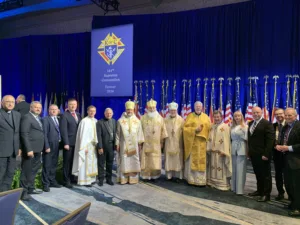
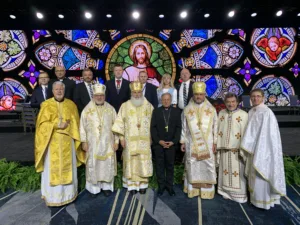
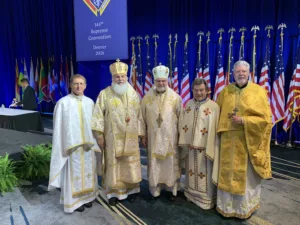


COR is a Knights of Columbus initiative that brings men together for prayer, faith formation, and brotherhood. The word cor means “heart” in Latin.
At Saint Nicholas, we meet once a month, beginning with Divine Liturgy at 9:00 AM, followed by coffee, prayer, faith formation, and open conversation.
It is a simple opportunity to step away from the busyness of life and spend some time with Christ and with other men.
Our current formation includes Men of the Word, a Knights of Columbus Bible study that helps us discover Christ through Sacred Scripture.
We also use our local theme, “Casting Into Deeper Waters,” inspired by Christ’s call to the fishermen. Like fishing, growing in faith requires patience, perseverance, and trust. We are called to go deeper in prayer, faith, responsibility, and our relationship with Christ.
You do not have to be a Knight to attend.
Whether you are a longtime parishioner, a newcomer to Canada, a man returning to the Church, or simply someone looking for deeper faith and good fellowship, come and join us.
Come for the Liturgy.
Stay for the coffee.
Bring your questions.
Meet other men.
Grow together in Christ.
Heart to heart — COR to COR.
Fr. Slavko Dumeč (о. Славко Думич)
Parish Priest, Saint Nicholas Ukrainian Catholic Church
State Chaplain, Knights of Columbus Alberta/Northwest Territories
COR — це нагода для чоловіків зупинитися серед щоденної метушні, помолитися, поспілкуватися та разом поглиблювати свою віру.
Щомісяця ми починаємо з Божественної Літургії о 9:00 ранку, а після Літургії зустрічаємося за кавою.
Говоримо просто і відкрито — про Бога, родину, працю, відповідальність, труднощі та життя.
Це не лекція і не чергове засідання.
Це час для чоловіків бути разом і нагадати один одному, що ми не самі у нашій дорозі віри.
Не потрібно бути членом Knights of Columbus.
Не потрібно знати всі відповіді.
Не потрібно бути «ідеальним католиком».
Просто приходьте.
Помолімося разом.
Вип’ємо кави.
Познайомимося.
Поговорімо про важливе.
Підтримаймо один одного.
Бо віра зростає, коли ми йдемо не самі, а разом.
Від серця до серця — COR до COR.
Every year on September 14, the Church celebrates one of the great feasts of the Christian year: the Exaltation of the Precious and Life-Giving Cross of our Lord.
At first, the feast may seem surprising. Why would Christians celebrate an instrument of execution? The Romans used the cross to humiliate and destroy. It was a symbol of shame, suffering, and death.
But Christianity turned that meaning upside down.
The Cross became the place where death was defeated by life, hatred by love, and sin by mercy.
The Cross is therefore not simply something we remember from the past. It is the sign of Christ’s victory.
As we sing in the Byzantine tradition:
“To Your Cross, O Master, we bow in veneration, and we glorify Your holy Resurrection.”
The Cross and the Resurrection cannot be separated. The Cross without the Resurrection would be tragedy. The Resurrection without the Cross would be impossible to understand.
The Feast of the Exaltation of the Precious and Life-Giving Cross has its roots in Jerusalem in the fourth century.
After the conversion of Emperor Constantine, Christianity was no longer an illegal and persecuted religion in the Roman Empire. Constantine ordered the construction of magnificent churches over the places associated with the death and Resurrection of Christ.
The great Church of the Holy Sepulchre in Jerusalem was solemnly dedicated in September of A.D. 335. The following day, September 14, the Cross of Christ was solemnly presented to the Christian people for veneration.
This is the historical foundation of the September 14 feast.
An ancient Christian pilgrim named Egeria, who visited Jerusalem in the fourth century, described the liturgical celebrations surrounding the Cross and the Holy Sepulchre. Her pilgrimage account is one of the earliest important descriptions we have of Christian worship in Jerusalem.
The feast eventually spread throughout the Christian world and became especially important in the Eastern Churches.
Here we come to one of Christianity’s most fascinating traditions.
The person traditionally associated with the discovery of the Cross is St. Helena, the mother of Emperor Constantine.
According to ancient Christian tradition, Helena traveled to Jerusalem in the fourth century searching for the places associated with Christ’s Passion and Resurrection.
The area of Calvary had undergone dramatic changes. Pagan structures had been built over the Christian holy places. According to tradition, the place where the Cross had stood was buried beneath the earth.
The story tells us that three crosses were discovered.
But which one belonged to Jesus?
According to the ancient tradition, the identity of Christ’s Cross was revealed through a miraculous healing. A sick woman was brought into contact with the crosses, and when she touched one of them she was healed.
That Cross was identified as the True Cross.
The historical evidence for every detail of this story is not equally strong, and the Church does not require us to treat every part of the later tradition as a scientifically demonstrated fact. Nevertheless, the tradition of Helena’s discovery of the Cross became deeply rooted in Christian memory and devotion.
St. Helena’s story becomes particularly interesting when we travel from Jerusalem to Rome.
Tradition says that Helena brought part of the Cross back to Rome. She also brought other relics associated with the Passion of Christ.
The place where these relics were preserved eventually became the Roman basilica known as:
Basilica of the Holy Cross in Jerusalem — Santa Croce in Gerusalemme.
The name itself is fascinating.
Why is there a church called “Holy Cross in Jerusalem” in Rome?
According to ancient tradition, soil from Jerusalem was brought to Rome and incorporated into the chapel associated with St. Helena. The basilica thus became almost a small piece of Jerusalem in the heart of Rome.
Even today, Santa Croce in Gerusalemme is one of the traditional pilgrimage churches of Rome.
And here the story becomes almost unbelievable.
If you visit Santa Croce in Gerusalemme, you encounter not simply a church dedicated to the Cross, but a collection of relics traditionally associated with the Passion of Christ.
Among them are:
The basilica itself describes these relics as part of its treasury and explains their traditional connection with the Passion.
Imagine standing in Rome and seeing objects that Christians have venerated for centuries as reminders of the events of Holy Week.
There is, however, an important practical detail for anyone planning a pilgrimage: the basilica’s official website currently states that the Chapel of the Relics is temporarily closed for urgent restoration work, with the reopening date to be announced.
Perhaps the most fascinating object at Santa Croce is the Titulus Crucis.
According to the Gospel of John, Pilate ordered an inscription to be placed above Jesus’ Cross:
“Jesus of Nazareth, King of the Jews.”
John tells us that the inscription was written in Hebrew, Latin, and Greek.
The wooden tablet preserved at Santa Croce contains an inscription associated with these three languages. The Latin portion includes the words traditionally read as:
I. NAZARINVS RE[X IVDAEORVM]
The tablet is relatively small and was discovered during restoration work in the fifteenth century. The basilica’s official account notes that the writing runs from right to left and includes Hebrew, Greek, and Latin characters.
There is also an intriguing scholarly question: Is this actually the original inscription from the Cross of Christ?
Here we need to be honest.
The Titulus Crucis has been the subject of historical, archaeological, and scientific debate. A radiocarbon study of a sample from the wood produced a medieval date rather than a first-century date. Other scholars have questioned whether the tested sample adequately represents the original object and have pointed to historical and paleographical arguments.
Therefore, the responsible way to speak about the Titulus is:
It is an ancient and extraordinarily interesting relic associated by tradition with the inscription placed above Christ’s Cross, but its first-century authenticity remains disputed.
That does not make it meaningless.
It reminds us that Christian faith is not based on possessing scientifically authenticated objects.
Our faith rests upon Christ Himself.
There is another fascinating question.
If fragments of the True Cross are preserved in Rome, Jerusalem, Constantinople, and many other places, how could there possibly be enough wood?
This question is actually very old.
Already in the fourth century, Christians knew that fragments associated with the Cross had been distributed throughout the Christian world. Over the centuries, very small fragments were divided and given to churches and monasteries.
One should therefore be cautious about popular claims that all the pieces of the True Cross in the world would make an enormous cross. Such calculations depend upon assumptions about relics that have not been scientifically established.
But there is an important historical point:
The widespread distribution of Cross relics is itself very ancient.
By the fourth century, Christians were already venerating and distributing pieces associated with the Cross.
The story of the Cross does not end with St. Helena.
In the seventh century, Jerusalem was attacked by the Persian king Chosroes II.
In A.D. 614, Persian forces captured Jerusalem and carried away the Cross.
For Christians, this was an enormous humiliation.
Years later, the Byzantine Emperor Heraclius defeated the Persians and recovered the Cross.
According to the traditional story, Heraclius wanted to return the Cross to Jerusalem dressed in imperial clothing, wearing his crown and royal garments.
But when he approached the city, he could not move forward.
The Patriarch explained that Christ had carried the Cross in humility.
The emperor therefore removed his imperial garments and entered carrying the Cross as a humble man.
Whether every detail of this story can be historically verified or not, its spiritual message is powerful:
You cannot carry the Cross of Christ with pride.
The Cross belongs to humility.
This is perhaps the greatest mystery of the feast.
The world saw the Cross as defeat.
Christians see it as victory.
The Romans said:
“This man has been conquered.”
The Church says:
“Through this man, death has been conquered.”
The Romans intended the Cross to say:
“You are powerless.”
The Gospel reveals:
“Love is stronger than death.”
That is why the Church does not simply commemorate the Cross.
She exalts it.
The Cross is raised high because Christ was raised high upon it—and through that apparent defeat came salvation.
This is an important question for modern Christians.
Why preserve a piece of wood?
Why preserve a nail?
Why preserve a thorn?
Why preserve a bone?
Because Christianity is not a religion of ideas only.
God became flesh.
Jesus had a real body.
He walked on real roads.
He touched real people.
He suffered under a real Roman execution.
He died on a real Cross.
He was placed in a real tomb.
And He rose bodily from the dead.
Relics remind us that Christianity is not mythology.
The Gospel happened in history.
At the same time, the Church does not worship pieces of wood, bones, or metal.
We worship Christ.
The relic points beyond itself to the person whom we love.
A piece of the Cross is valuable because of whose Cross it is.
There is an even deeper point.
Suppose one day scientists proved beyond every doubt that a particular fragment of wood came from the Cross of Jesus.
Would that make Jesus more our Savior?
No.
And if tomorrow another relic were proven to be medieval, would Christ cease to be our Savior?
Absolutely not.
Our salvation does not depend upon archaeology.
It depends upon Jesus Christ.
The relics are signs.
They point us toward the reality.
And the reality is this:
The Son of God loved us so much that He entered our suffering and carried our sins upon the Cross.
That is what we celebrate on September 14.
There is something very beautiful in the Eastern Christian celebration of this feast.
The Cross is brought into the church and raised high.
The priest and people bow before it.
The Cross is lifted up so that everyone can see it.
Why?
Because the Church wants us to understand:
Do not run away from the Cross.
Look at it.
Look at what God has done with suffering.
Look at what love can do.
Look at Christ.
The Cross tells us that God does not remain distant from human suffering.
He enters it.
He carries it.
And finally, He transforms it.
Every Christian carries a cross.
Sometimes it is illness.
Sometimes it is grief.
Sometimes it is family problems.
Sometimes it is loneliness.
Sometimes it is forgiveness that seems impossible.
Sometimes it is simply remaining faithful when life becomes difficult.
The Cross of Christ does not promise us a life without suffering.
It promises us that suffering does not have the final word.
The Cross leads to Resurrection.
That is why the Cross is called Life-Giving.
The wood on which Christ died becomes, mysteriously, the tree of life.
The instrument of death becomes the sign of salvation.
And the place of shame becomes the throne of the King.
Perhaps one day you will stand in Rome before the relics of Santa Croce in Gerusalemme.
You may see a small piece of wood.
A nail.
A thorn.
An ancient inscription.
And you may wonder:
“Is this really the object that touched Jesus?”
That is a reasonable question.
But there is another question that is even more important:
“Has the Cross of Jesus touched my life?”
Because the most important Cross is not the one behind glass in Rome.
It is the Cross that we carry with Christ.
It is the Cross we make when we forgive.
It is the Cross we accept when we remain faithful.
It is the Cross we embrace when we choose love instead of revenge, sacrifice instead of selfishness, and faith instead of despair.
And beyond every relic, every archaeological discovery, every ancient basilica and every pilgrimage road stands one eternal truth:
Christ has conquered through the Cross.
Therefore, on September 14, the Church does not look at the Cross with fear.
She raises it high.
She bows before it.
And she proclaims:
“To Your Cross, O Master, we bow in veneration, and we glorify Your holy Resurrection.”
14 вересня Церква святкує Воздвиження Чесного і Животворящого Хреста Господнього.
Для світу хрест колись був знаком ганьби, страждання і смерті. Це було знаряддя римської страти.
Але після Христа все змінилося.
Те, що було знаком смерті, стало знаком життя. Те, що мало означати поразку, стало знаком перемоги. На Хресті Христос віддав Себе за нас — і саме через Хрест відкрив нам дорогу до Воскресіння.
Тому у Східній Церкві ми молимося:
«Христу Твоєму поклоняємось, Владико, і святе Воскресіння Твоє славимо».
Хрест і Воскресіння нероздільні.
Історія празника веде нас до Єрусалима IV століття.
Після навернення імператора Костянтина християни отримали можливість відновити святі місця, пов’язані із земним життям Ісуса.
У Єрусалимі була споруджена велична церква Гробу Господнього, яку урочисто освячено у 335 році. Наступного дня, 14 вересня, Хрест Господній був піднесений перед народом для почитання.
Так поступово сформувався празник, який сьогодні святкує вся Східна Церква.
Давня паломниця Егерія, яка відвідала Єрусалим у IV столітті, залишила нам один із найдавніших описів богослужень біля Гробу Господнього та Чесного Хреста.
З віднайденням Хреста християнська традиція особливо пов’язує святу Олену, матір імператора Костянтина.
За давнім переданням, вона прибула до Єрусалима і шукала місце, де був розп’ятий Христос.
Під час розкопок, за переданням, було знайдено три хрести. Але який із них був Христовим?
Традиція розповідає про чудесне зцілення хворої жінки. Дотик до одного з хрестів приніс їй зцілення — і саме цей Хрест був визнаний Чесним Хрестом Господнім.
Не кожну деталь цієї давньої розповіді можна сьогодні підтвердити історично. Але пам’ять про святу Олену та віднайдення Хреста протягом століть залишається важливою частиною християнського передання.
Історія Хреста веде нас не тільки до Єрусалима, але й до Рима.
За традицією, свята Олена привезла до Рима частину Хреста та інші реліквії, пов’язані зі Страстями Христовими.
Так виникла знаменита базиліка Santa Croce in Gerusalemme — Святий Хрест в Єрусалимі.
Назва здається дивною: чому «в Єрусалимі», якщо церква знаходиться в Римі?
За давнім переданням, разом із реліквіями свята Олена привезла до Рима землю з Єрусалима. Так ця святиня стала своєрідним маленьким Єрусалимом у самому серці Рима.
І сьогодні Santa Croce є одним із традиційних місць паломництва в Римі.
У базиліці зберігаються реліквії, які християнська традиція пов’язує зі Страстями Господніми:
Офіційний сайт базиліки підтверджує, що ці реліквії й сьогодні є частиною її скарбниці. Щоправда, на даний час каплиця реліквій тимчасово закрита через реставраційні роботи.
Цікаво, що серед цих реліквій є навіть частинка, яку традиція пов’язує з хрестом доброго розбійника.
Це дуже промовисто.
На Голготі поруч із Христом був чоловік, який у останню мить життя відкрив своє серце Богові.
Навіть його хрест залишився для християн пам’яттю про милосердя.
Однією з найцікавіших реліквій є Titulus Crucis — дерев’яна табличка, яку традиція пов’язує з написом, поміщеним над головою Ісуса:
«Ісус Назарянин, Цар Юдейський».
Євангеліє від Йоана говорить, що напис був зроблений єврейською, латинською та грецькою мовами.
Табличка в Santa Croce має саме таку традиційну історію.
Але тут потрібно бути чесними: її автентичність як оригінального напису з Хреста Христа залишається предметом наукових дискусій. Дослідження деревини викликали питання щодо її датування.
Для віри це не є проблемою.
Наша віра не залежить від того, чи зможемо ми довести походження кожного шматочка дерева.
Наша віра залежить від Христа.
Реліквія лише допомагає нам спрямувати погляд до Нього.
У 614 році Єрусалим був захоплений перськими військами, а Хрест Господній був вивезений із міста.
Через роки візантійський імператор Іраклій переміг персів і повернув Хрест.
За давнім переданням, імператор хотів урочисто внести його до Єрусалима у царському одязі. Але йому нагадали, що Христос ніс Хрест у смиренні.
Тоді Іраклій зняв царські шати й увійшов до міста, несучи Хрест смиренно.
Можливо, не кожна деталь цієї розповіді може бути історично доведена, але її послання залишається дуже сильним:
Хрест Христовий неможливо нести з гордістю.
Він завжди веде нас до смирення.
Тому що Христос перетворив його значення.
Світ побачив у Хресті поразку.
Церква побачила перемогу.
Світ побачив смерть.
Церква побачила початок нового життя.
Дерево, на якому Христос помер, стало для нас деревом життя.
Тому ми не просто згадуємо Хрест.
Ми його воздвигаємо.
Ми підносимо його високо, щоб наші очі знову і знову зверталися до Христа.
Празник Воздвиження говорить не тільки про те, що сталося в Єрусалимі багато століть тому.
Він говорить і про наше життя.
Кожен із нас має свій хрест.
Іноді це хвороба. Іноді втрата. Іноді труднощі в сім’ї. Іноді самотність. Іноді необхідність пробачити. А іноді — просто залишатися вірним Богові тоді, коли це важко.
Христос не обіцяв нам життя без хреста.
Він показав нам, як нести його разом із Ним.
І найважливіше: Хрест не має останнього слова.
Останнє слово належить Воскресінню.
Саме тому наш Хрест є Животворящим.
Можливо, колись ви будете в Римі й побачите Santa Croce in Gerusalemme.
Можливо, перед вами буде маленька частинка дерева, цвях, тернина чи давній напис.
І природно буде запитати:
«Чи це справді те, до чого торкався Ісус?»
Але є питання важливіше:
«Чи торкнувся Хрест Ісуса мого життя?»
Бо найважливіший Хрест — не той, що зберігається за склом у Римі.
Це Хрест, який ми приймаємо, коли прощаємо.
Хрест, який несемо, коли залишаємося вірними.
Хрест, який стає любов’ю, коли ми вибираємо жертовність замість егоїзму, милосердя замість помсти і віру замість відчаю.
Тому сьогодні Церква підносить Чесний Хрест високо перед нами і нагадує:
Христос переміг через Хрест.
І разом із усією Церквою ми поклоняємося Йому та сповідуємо:
«Христу Твоєму поклоняємось, Владико, і святе Воскресіння Твоє славимо».
On Tuesday, September 8, the Church celebrates the Nativity of the Most Holy Theotokos, the birth of Mary, the Mother of our Lord Jesus Christ.
It is a beautiful feast of joy, but also a feast filled with mystery. The Gospel does not tell us the story of Mary’s birth. Yet the Church has celebrated it from ancient times because Mary’s birth belongs to the beginning of God’s plan to restore His creation.
The Church sings:
“Your Nativity, O Virgin Mother of God, has proclaimed joy to all the world, for from you has dawned the Sun of Righteousness, Christ our God.”
Mary is the dawn.
Christ is the Sun.
Her birth announces that the long night will not last forever.
To understand the beauty of this feast, we can go back to the beginning.
God placed Adam in the Garden of Eden to cultivate it and care for it. Humanity was entrusted with God’s beautiful creation. But through disobedience, Adam and Eve lost Paradise. Sin entered the world, and with sin came death.
Yet God did not abandon His creation.
He began preparing the way for its restoration.
And here the Church gives us a beautiful image in her prayers to the Theotokos: Mary is a garden, a paradise planted by God, in which the Tree of Life grows.
From this garden comes forth Christ.
The first garden was the place where humanity lost the way to the Tree of Life. The garden of Mary becomes the place where the Tree of Life begins to grow again.
Mary receives the Word of God, and from her the eternal Word takes flesh.
The Church sees Mary as the New Eve.
Eve heard the word that led humanity away from God. Mary hears God’s word and responds:
“Let it be done to me according to your word.”
Her humble “yes” becomes part of God’s great “yes” to humanity.
And the Son whom she bears is the New Adam.
The first Adam was placed in a garden to care for creation. And then, at the Resurrection, Christ appears in another garden.
Mary Magdalene sees Him but does not recognize Him. She thinks He is the gardener.
Perhaps, in a beautiful Christian meditation, she was not entirely wrong.
Christ, the New Adam, has entered the garden again.
But this time He has not come merely to cultivate the earth.
He has come to restore creation itself.
The first Adam’s disobedience brought death through the tree.
Christ’s obedience upon the wood of the Cross brings life.
The Cross becomes for us the Tree of Life.
And the risen Christ does not keep this life for Himself. He gives Himself to us.
He tells us:
“Whoever eats my flesh and drinks my blood has eternal life… Whoever eats my flesh and drinks my blood remains in me and I in him.”
At every Divine Liturgy, we approach the Holy Gifts and receive the Body and Blood of the risen Christ.
The Fruit of Life is no longer something humanity must reach for.
It is given to us.
And it is given to us through Christ.
This is why the Nativity of the Theotokos is not simply a celebration of Mary’s birthday.
It is a celebration of God’s faithfulness.
God did not forget humanity after the Fall.
He did not abandon His creation.
He continued His work quietly and patiently until, in the fullness of time, Mary was born—the one who would freely say yes to God and become the Mother of His Son.
Her birth is the beginning of a new dawn.
As the Church sings, “Today is the beginning of our salvation.”
The darkness will not have the final word.
Death will not have the final word.
The tomb will not have the final word.
Christ will.
Perhaps this is what Mary gives us most beautifully: hope.
God can begin something wonderful in what appears small and ordinary.
A child is born.
A family rejoices.
A young woman says yes to God.
And through that humble beginning, the Savior of the world enters our humanity.
So on this feast, let us rejoice with Joachim and Anna. Let us rejoice with the Mother of God. And above all, let us rejoice in the Son whom she brings into the world.
The garden is prepared.
The dawn has appeared.
The Tree of Life has grown.
And its Fruit is Christ, who gives life to the world.
Please join us this Tuesday, September 8, at 7:00 PM at Saint Nicholas Ukrainian Catholic Church as we celebrate the Nativity of the Most Holy Theotokos.
Come and rejoice with us.
Come and stand at the dawn.
And with Mary, let us always turn our hearts toward her Son, Jesus Christ, the Sun of Righteousness, the New Adam, and the Giver of eternal life.
8 вересня Церква радісно святкує Різдво Пресвятої Богородиці.
Це тихе, але велике свято. Народжується Дитя, про яке Євангеліє ще нічого не розповідає. А Церква вже співає:
«Різдво Твоє, Богородице Діво, радість звістило всій вселенній…»
Чому така радість?
Бо з народженням Марії починає світати світанок нашого спасіння.
Щоб відчути красу цього свята, треба повернутися до початку.
Бог оселив людину в раю і поставив Адама обробляти та доглядати сад. Йому було довірено Боже творіння.
Але через непослух людина втратила рай. Плід забороненого дерева приніс у світ гріх і смерть, і шлях до Дерева Життя був закритий.
Та Бог не залишив людину.
Він почав готувати новий сад.
У молитвах і піснеспівах Церкви Богородицю називаємо раєм, насадженим Богом, садом, у якому проростає Дерево Життя.
Цим Деревом є Христос.
З Марії приймає людське тіло Предвічне Слово.
Те, що було втрачено в першому раю, починає відновлюватися.
Церква бачить у Марії Нову Єву.
Єва почула слово, яке відвело людину від Бога.
Марія почула слово Боже і відповіла:
«Нехай мені станеться за твоїм словом».
Одне «так» людини Богові — і Слово стало тілом.
Тому сьогодні ми святкуємо не просто народження великої жінки. Ми святкуємо початок тієї дороги, якою Бог приходить до нас у Христі.
Марія — світанок.
Христос — Сонце Правди.
І знову зустрічаємо сад.
Вранці після Воскресіння Марія Магдалина стоїть біля порожнього гробу. Вона бачить Ісуса, але не впізнає Його. Думає, що перед нею садівник.
Можливо, вона була не такою вже й далекою від правди.
Першому Адамові був довірений сад першого творіння.
Христос, Новий Адам, приходить у сад Воскресіння, щоб відновити те, що було втрачене.
Перше дерево стало свідком людського непослуху.
Дерево Хреста стає свідком Христової любові та послуху.
І Хрест стає для нас Деревом Життя.
Але Христос не залишає нам лише спогад про життя.
Він дає нам Себе.
Він говорить:
«Хто їсть Моє тіло і п’є Мою кров, той має життя вічне… хто їсть Моє тіло і п’є Мою кров, той у Мені перебуває, і Я в ньому».
На кожній Божественній Літургії ми приступаємо до Святих Таїн і приймаємо Тіло і Кров воскреслого Христа.
Плід Дерева Життя вже не треба шукати.
Він дарується нам.
Не як те, що ми самі можемо здобути, а як дар Божої любові.
Тому Різдво Богородиці — це свято великої надії.
Бог не забув людину.
Не залишив Свого творіння.
Не дозволив темряві сказати останнє слово.
У маленькому містечку народжується маленька Дитина.
І ніхто ще не бачить, що через Неї Бог готує світові найбільший Дар.
Сад приготовлений.
Дерево Життя проростає.
Світанок уже займається.
А з Марії сходить Христос — Сонце Правди, Той, хто смертю смерть подолав і дарував нам життя вічне.
Тож у цей день радіймо разом із Церквою і разом із Пресвятою Богородицею.
Бо там, де починається її земне життя, вже починає світати радість нашого спасіння.
Запрошуємо вас цього вівторка, 8 вересня, о 7:00 вечора до церкви Святого Миколая, щоб разом відсвяткувати Різдво Пресвятої Богородиці.
Прийдімо з нашими родинами, з нашими радощами і турботами.
Прийдімо до цього світанку.
І разом із Марією звернімо наш погляд до Її Сина —
Ісуса Христа, Нового Адама, Дерева Життя і Подателя життя вічного.
September has a special feeling.
The days begin to change. The mornings are cooler. Children and young people return to school. Teachers return to their classrooms. Parents return to busy schedules. Our homes, workplaces, schools, and churches begin to come alive again.
September feels like a new beginning.
For us as Christians, September brings an even deeper beginning. September 1 marks the beginning of the new liturgical year in the Byzantine Christian tradition. The Church gives us a new year not simply so that we can turn another page on the calendar, but so that we can turn our hearts again toward God.
It is an invitation to begin again.
Perhaps this summer was wonderful for you. Perhaps it was difficult. Maybe you are returning to September full of energy and hope. Maybe you are tired and carrying worries that no one else can see.
Perhaps during the summer you prayed more—or perhaps you drifted away from prayer. Maybe you came to church regularly, or maybe you missed more Sundays than you intended. Maybe there are things you are proud of, and other things you wish you could do differently.
September gives us a beautiful message:
You can begin again.
God does not simply say, “You should have done better.”
He says, “Come back to me.”
When I look back at this summer, I see many reminders of how precious life is and how God continues to work among us.
We experienced the sadness of losing a dedicated parishioner, Adolf “Ed.” His faithful presence among us was a gift, and his passing reminds us that our time here is precious. We give thanks to God for his life and entrust him to the Lord.
At the same time, we experienced the joy of new life in the Church as a young priest, Fr. Peter Pichko, was ordained in our Eparchy. One generation passes on the faith, and another generation steps forward to serve the Church.
And, God willing, in just a few weeks I will experience another kind of new beginning in my own family. For the first time, I will become a Дідо (Grandpa). Some of you will be experiencing that same joy in your own families.
Life continues.
One generation leaves us. Another is born. Young people answer God’s call. Families grow. The Church receives new servants.
And through all of this, God continues to give life.
The Bible begins with these words:
“In the beginning, God created the heavens and the earth.”
God gives life.
He creates because He is good. He gives because He loves.
Your life is not an accident. You are wanted. You are created in God’s image. You have been given a mind to think, a heart to love, hands to serve, and a life to offer back to God.
God did not create us simply to exist.
He created us to know Him, love Him, and live in communion with Him.
That is why the Church matters.
The Church is not simply a building where we come on Sunday. It is a family where God gathers His children. Here we hear His Word, learn to pray, receive His mercy, encounter Christ, and receive His life in the Holy Eucharist.
God does not simply want to give us a good life.
He wants to give us His own life.
From the very beginning, however, we see what happens when we stop trusting God.
God gave Adam and Eve everything they needed. But they reached for what God had not given them. They wanted to take life into their own hands.
Sin entered the world, and immediately they hid.
Isn’t that still what we do?
When we sin, we sometimes hide from God. We stop praying. We stop coming to church. We become ashamed. We think, “I have gone too far.” “God must be disappointed in me.” “Maybe I don’t belong anymore.”
But God did not abandon Adam and Eve.
He called to them:
“Where are you?”
God knew where they were. He was not asking for their location.
He was asking about their relationship with Him.
Where are you?
Where is your heart?
Where is your faith?
Where is your hope?
Where have you been hiding?
Perhaps September is the right time to answer that question.
If you have been away from the Church, come home.
If you have stopped praying, begin with one prayer.
If you are carrying anger, ask God for the grace to forgive.
If you have fallen into sin, don’t run away from God. Run toward Him.
Come to Confession. Come to Divine Liturgy. Come to the Eucharist worthily. Come among your brothers and sisters in faith.
Bring your children. Bring your grandchildren. Bring your questions, your worries, your joys, and even your struggles.
You do not need to have everything figured out before you come to God.
Come because you need Him.
To our children and young people, I want to say something very simple:
This year, don’t search only for good grades. Search also for God.
Learn your subjects. Work hard. Do your best.
But also learn how to be kind. Learn how to forgive. Learn to tell the truth. Stand up for someone who is being bullied. Notice the person who is lonely. Learn to pray.
And remember: God goes with you.
To parents, your children need many things. They need food, clothing, education, activities, and opportunities.
But one of the greatest gifts you can give them is an example of a life that has room for God.
Let them see you pray.
Let them see you forgive.
Let them see you come to church.
Let them see that your faith remains strong even when life is difficult.
To our teachers: thank you. You are not only teaching subjects. You are helping form human beings. May God give you patience, wisdom, strength, and joy for the year ahead.
September is a new beginning for all of us—not only for children.
Perhaps this year we can make one simple decision:
“I will make more room for God in my life.”
Not tomorrow, when life becomes less busy.
Not when everything is finally under control.
Now.
Make time for Divine Liturgy. Make time for daily prayer. Open the Gospel. Go to Confession. Receive the Eucharist worthily. Take a few quiet moments to speak with God and listen to Him.
Our faith is not something separate from Monday morning.
God belongs in our work, our families, our farms, our schools, our businesses, our friendships, our bills, our celebrations, and our difficult days.
God wants to be present in all of our life.
There are also signs of new beginnings right here around our parish.
On Monday, August 31, our new sidewalks and newly paved roads around the church were completed. This summer, I had the opportunity to speak with some of the men who were working on the construction. Many of them were young men from Ukraine.
I found myself thinking about how often God places people right at our doorstep.
The road that brings us to our church has been renewed.
Perhaps that is a little reminder for us:
A renewed road invites us to take a renewed step toward God.
This summer also brought us plenty of rain, flooding, and smoke. Hay was cut later than usual. Now autumn is arriving, and in the woods we begin to see підпеньки (honey mushrooms).
Soon, perhaps in a week or two, the combines will be out in the fields and the harvest will begin.
This is the rhythm of creation.
We plant. We wait. We grow. We harvest.
Sometimes our spiritual lives are like that too.
We pray and do not immediately see results.
We try to change and nothing seems to happen.
We plant a little seed of faith in a child. We say one more prayer. We forgive someone. We come back to Confession. We make one small step toward God.
And we wait.
But we should never forget:
The Creator has not stopped creating.
He is still bringing life out of what seems empty. He is still renewing hearts. He is still calling people. He is still giving new beginnings.
I did not have as much time this summer as I had hoped for fishing or camping. Perhaps there will be some time this fall. And if not, perhaps January will bring an opportunity for ice fishing!
Even that reminds me that we live through different seasons. We do not always get to do everything we planned. But another season comes, and with it comes another opportunity.
God gives us time. God gives us seasons. God gives us life.
This coming Tuesday, September 8, we celebrate the Nativity of the Most Holy Theotokos.
This feast reminds us of the fulfillment of God’s salvific promise. God’s people waited and prayed, and in the birth of Mary we see another beautiful step in God’s plan of salvation.
God is faithful to His promises.
Sometimes we have to wait. Sometimes God works quietly, in ways we cannot yet see.
But God does not forget.
The birth of Mary prepares the way for the coming of Christ.
And once again, the Church reminds us:
God is bringing new life.
We also see new life beginning right here in our parish.
On September 1, our own parishioner, Alex Kusche, officially began his journey in the seminary.
What a beautiful sign of hope for our parish and for the Church.
God is still calling.
Let us pray for Alex as he begins this journey. Let us pray for all our seminarians and for young people who are discerning God’s call. A vocation is God’s gift and a person’s journey of discernment, and our role as a parish is to encourage, pray, support, and accompany.
We also have opportunities this year to grow deeper in our faith through Bible studies and catechetical formation, including opportunities led by Seminarian Marko Koval, as well as COR formation that I will lead.
These are not simply more activities to put on a busy calendar.
They are opportunities to grow, learn, pray, ask questions, and deepen our relationship with Christ.
This is the kind of parish I hope we can continue to build together.
A parish where children are welcome.
Where young people know they have a home.
Where parents find support.
Where our seniors know they are valued and never forgotten.
Where newcomers are truly welcomed.
Where those who are struggling find compassion.
Where those who have wandered away know that the door is still open.
We do not want newcomers simply to find help here.
We want them to find a home.
A home where they can pray and worship. A home where they can build friendships, raise their families, and become active members of our parish community.
The young men from Ukraine who worked on our roads this summer can remind us of something important: sometimes God brings people right to our doorstep.
Let us notice them.
Let us welcome them.
Let us invite them.
And let us remember:
There is a place for you here.
There is also a place for each of us to serve.
Some sing. Some teach. Some cook. Some organize. Some visit the sick. Some work quietly behind the scenes. Some give generously. Some simply pray. Some offer a smile or a word of encouragement.
Every gift matters.
Perhaps this is the most important message for this new beginning:
God is not finished with you.
Your past does not determine your future.
Your failures are not the end of your story.
Your age does not disqualify you.
Your weaknesses do not frighten God.
Your questions do not scare Him.
Your wounds do not make you unworthy of His love.
The God who created you continues to call you.
He called Adam.
He called Abraham.
He called Mary.
He called the Apostles.
He called saints throughout history.
And Jesus continues to say:
“Come, follow me.”
You do not need to change your whole life in one day.
Start with one step.
Come to church.
Say a prayer.
Open the Gospel.
Go to Confession.
Forgive someone.
Call someone who is lonely.
Bring your family to Divine Liturgy.
Take your child by the hand and walk through the doors of the church.
And simply say:
“Lord, I am here. Begin again with me.”
The school year will end.
The seasons will change.
Leaves will fall.
Snow will come.
Another year will pass.
The harvest will be gathered.
Children will grow.
New children will be born.
New families will arrive.
New priests will be ordained.
And some of our loved ones will leave this earthly life and return to the Lord.
But God remains.
His love remains.
His mercy remains.
His invitation remains.
The liturgical year is a journey toward God. As we walk through it, we walk with Christ—through His birth, His teaching, His Cross, His Resurrection, and the gift of new life.
The story that began with creation leads us toward new creation.
So perhaps this September we should ask not only:
“What will this year bring me?”
but:
“What is God inviting me to become?”
Come out of hiding.
Come home.
Begin again.
Begin with God.
Вересень приходить тихо.
Після літа стає прохолодніше, діти повертаються до школи, поля готуються до жнив, а природа нагадує нам: кожна пора має свій початок.
Так само і в житті.
Кожному з нас іноді потрібен новий початок.
1 вересня Церква розпочинає новий церковний рік. Це добра нагода не тільки перегорнути сторінку календаря, але й подивитися на своє життя та запитати:
Куди я йду?
Що сталося з моєю вірою?
Чи є в моєму житті місце для Бога?
Можливо, минулий рік був добрим.
Можливо, був важким.
Можливо, ми наблизилися до Бога, а можливо — непомітно відійшли.
Але Бог дає нам новий день.
І з Богом завжди можна почати знову.
Святе Письмо починається словами:
«На початку Бог створив небо і землю».
Бог є Творцем життя.
І Він не перестає творити.
Він дає нове життя нашим сім’ям, нову надію втомленому серцю, силу тому, хто переживає труднощі, і світло тому, хто вже не бачить дороги.
Цього літа ми побачили багато таких початків: хтось народився, хтось відійшов до Господа, хтось почув покликання, хтось зробив перший крок у нове служіння.
Життя змінюється.
А Бог залишається поруч.
Можливо, саме тому ви сьогодні відкрили цю сторінку.
Можливо, ви давно не були в церкві.
Можливо, приходите лише кілька разів на рік — на Різдво, Великдень, хрестини, вінчання чи похорон.
Можливо, минуло багато років.
Не бійтеся повертатися.
Бог не питає:
«Чому тебе так довго не було?»
Він просто говорить:
«Я чекаю на тебе».
Не потрібно знати всі молитви.
Не потрібно спочатку все виправити.
Не потрібно бути досконалим.
Зробіть лише один маленький крок.
Прийдіть.
Постойте в храмі.
Помоліться.
Поговоріть зі священником.
Відкрийте Святе Письмо.
Поверніться до Сповіді.
І дозвольте Богові почати щось нове у вашому житті.
Цієї осені ми також оновили дорогу і тротуари біля нашого храму.
Дорога стала новою.
Можливо, це добра нагода і для нас зробити новий крок до Бога.
Бо іноді ми не знаємо, куди йти.
Але не обов’язково бачити всю дорогу.
Достатньо зробити перший крок.
Наша парафія хоче бути місцем, де людина може прийти такою, якою вона є.
Місцем для дітей і молоді, для сімей і старших, для тих, хто давно в Церкві, і для тих, хто тільки шукає дорогу.
Якщо ви нові в нашій громаді — ласкаво просимо.
Якщо ви давно не були — ласкаво просимо додому.
Ми не хочемо бути лише місцем, куди приходять за допомогою.
Ми хочемо бути домом.
Домом, де можна молитися, знайти друзів, виховувати дітей у вірі, поставити запитання і знову відчути Божу присутність.
Для вас тут є місце.
Цього року в нашій парафії будуть нові можливості для молитви, біблійних зустрічей, катехизації та формації.
Не для того, щоб просто додати ще щось до нашого календаря.
А щоб допомогти нам краще пізнати Бога і наблизитися до Нього.
А 8 вересня ми святкуємо Різдво Пресвятої Богородиці — свято, яке нагадує нам, що Бог здійснює Свою обітницю спасіння, навіть тоді, коли люди ще не бачать її здійснення.
Можливо, і у вашому житті Бог уже готує щось нове.
Тому не бійтеся нового початку.
Бог ще не закінчив Свою працю у вас.
Цієї осені зробімо один маленький крок.
До храму.
До молитви.
До Сповіді.
До Божого Слова.
До Христа.
А може, просто скажімо:
«Господи, я тут.
Допоможи мені почати знову».
І цього буде достатньо.
Нова пора.
Новий церковний рік.
Нова дорога.
Новий початок.
Почнімо з Богом.
Saturday, August 29, 2026
🕀 The Beheading of the Honourable and Glorious Prophet, Forerunner and Baptist John
All-Night Vigil Feast
Among the great feasts of our Byzantine Christian tradition, the Beheading of Saint John the Baptist is one of the most solemn. It is not a joyful feast in the ordinary sense. We gather to remember the martyrdom of the one whom Christ called the greatest born of woman.
Saint John died because he refused to remain silent in the face of sin.
He told King Herod plainly:
“It is not lawful for you to have your brother’s wife.”
John could have protected himself by remaining quiet. He could have pleased the king. Instead, he remained faithful to God’s truth — and paid for it with his life.
The Church therefore remembers him not simply as a prophet, but as a martyr for truth.
The Ukrainian Greek Catholic Church continues to celebrate this feast on August 29 according to the revised calendar. The 2026 UGCC calendar lists the Beheading of Saint John the Baptist on August 29 with the Vigil and the Divine Liturgy readings from Acts 13 and Mark 6.
The Gospel tells us the tragic story.
King Herod had taken Herodias, the wife of his brother, as his own. Saint John publicly condemned this unlawful relationship. Herod therefore imprisoned John.
During a banquet, Herodias’ daughter danced before the king and his guests. Herod, carried away by the moment, promised to give her whatever she asked. At her mother’s urging, she asked for the head of John the Baptist.
Herod knew that John was righteous. He was troubled by the request, but because of his pride, his promise and his concern about what his guests would think, he gave the order.
John was beheaded in prison.
His disciples came, took his body and buried him.
This terrible event is the reason why this day is observed with such seriousness.
The Church’s hymns, however, do not end the story with John’s death. The Kontakion reminds us that the Forerunner continued to proclaim Christ even to those in Hades. His death was not the victory of Herod. Truth was not defeated.
As the Ukrainian Greek Catholic Synod has recently emphasized, John’s death was not a defeat but a victory of truth over human evil and fear.
The Beheading of Saint John the Baptist is traditionally observed as a strict fast because we are remembering the violent death of the Lord’s Forerunner. This practice is shared broadly throughout the Byzantine Christian tradition.
The fast is not meant to be a punishment.
It is a way of saying:
“Today I remember what happened. I remember the cost of sin. I remember the courage of God’s servant. And I want to examine my own life.”
Our fasting should therefore lead us to prayer, repentance, simplicity and charity.
It is especially appropriate on this day to ask:
The fast is not simply about what we put out of our mouths. It is also about what comes out of our mouths.
Perhaps on this day we should fast not only from certain foods, but also from gossip, complaining, anger, insults and unnecessary arguments.
This is one of the most interesting customs associated with the feast.
In many Ukrainian and other Eastern European traditions, people traditionally avoided using a knife, axe or other sharp tool on the day of the Beheading.
Food was not cut with a knife. Bread could be broken by hand. Some foods were prepared in a way that did not require cutting.
The reason is simple: the knife reminded people of the instrument used to take John’s life.
This custom is found in several Eastern Christian cultures. Some traditions also avoided serving food on a large flat platter because Saint John’s head was presented to Herodias on a platter.
This is a beautiful example of how our ancestors tried to make the Gospel concrete.
They did not simply hear the story in church.
They remembered it at the kitchen table.
Here the customs become especially interesting — and sometimes quite different from one Ukrainian village or region to another.
Many people traditionally avoided round fruits and vegetables, because their shape reminded them of a human head.
These could include:
Some Ukrainian traditions also avoided red foods, such as tomatoes, red peppers, red apples and red wine, because the colour reminded people of blood.
Cabbage received special attention in some traditions because it is round and because folklore connected its shape and leaves with the story of John’s beheading.
Some communities even avoided borscht on this day. The explanation varied: the vegetables were cut, some were round, and the red colour of the soup reminded people of blood.
But it is important to understand this correctly:
The Church does not teach that an apple, onion, cabbage or tomato is sinful on August 29.
These are traditional devotional customs, not universal Church laws.
The actual spiritual meaning is much more important than the vegetable.
If someone eats an apple on August 29, they have not committed a sin.
If someone avoids an apple but spends the day gossiping, judging others and refusing to forgive, they have missed the point of the feast.
Another old custom was to avoid dancing, singing and noisy celebrations.
The reason comes directly from the Gospel.
John’s death occurred because Herod was carried away by a banquet, his passions, the dancing of Salome, alcohol, pride and the desire to impress his guests.
Therefore, popular Christian tradition turned away from these things on this solemn day.
Some communities also avoided celebrating birthdays or holding large parties because Herod’s birthday banquet became the setting for John’s murder.
Again, this is a traditional devotional practice rather than a universal Church prohibition.
The message is more important than the rule:
Do not let pleasure, pride or the opinion of other people make you forget what is right.
Our Ukrainian ancestors had a very practical faith.
On this day, even preparing food could become a reminder of the Gospel.
Instead of cutting bread, they broke it.
Instead of using a knife to cut fruit, they might leave it aside.
Instead of preparing a large and elaborate meal, they kept the table simple.
The purpose was not superstition.
The purpose was remembrance.
The family could look at the simple table and remember:
John gave his life because he would not betray God’s truth.
That is why some old customs may seem strange to us today, but behind them was a very human desire: to make faith part of everyday life.
In Ukrainian folk tradition, the Beheading of Saint John was also connected with the changing of the seasons.
By the end of August, the harvest was being gathered, the days were becoming shorter, and people could feel that summer was coming to an end.
The day was therefore sometimes associated with the beginning of autumn and the preparation for the colder months.
This gave the feast another meaning: a reminder that earthly seasons change, and human life also passes.
The Church’s Kontakion makes the same spiritual point when it contrasts the “false and transitory age” with the life that comes from God.
Everything around us changes.
Our health changes.
Our work changes.
Our families change.
Our possessions disappear.
But God’s truth remains.
The best traditions are those that lead us closer to Christ.
On August 29, we can:
Go to Divine Liturgy.
The feast is marked in the UGCC calendar as a major celebration, with Vigil and Divine Liturgy.
Keep the fast.
Choose simple fasting food and remember why you are fasting.
Pray for courage.
Ask Saint John to help you remain faithful when it is difficult to do what is right.
Examine your conscience.
Where have you compromised God’s truth because you were afraid of what others would say?
Avoid unnecessary celebrations and excess.
Keep the day quiet and prayerful.
Give something to someone in need.
Our ancestors often connected solemn feast days with charity and hospitality.
Forgive someone.
Saint John preached repentance. His feast should move us toward repentance in our own lives.
Teach the children.
Tell them the story of Saint John. Explain why we fast. Explain why some people traditionally avoided knives and certain foods. Let them see that our faith is not only something we do in church.
There is a great deal of folklore surrounding the Beheading of Saint John the Baptist.
Some customs are beautiful reminders of the Gospel. Others developed from local beliefs and symbolism. Some are different from village to village.
We should therefore not turn every old custom into a religious law.
The Church asks us to fast and remember the martyrdom of Saint John.
Our ancestors added customs to help themselves remember.
The knife reminded them of the sword.
The round apple reminded them of the head.
The red food reminded them of blood.
The simple table reminded them of John’s life of simplicity.
The silence reminded them of the tragedy of Herod’s banquet.
These customs can still teach us something — if we understand what they are meant to teach.
Perhaps this is the most important lesson of the feast.
Herod knew John was a righteous man.
The Gospel even tells us that Herod liked listening to him.
But Herod could not bring himself to obey the truth.
He was more concerned about his guests than about God.
That is a danger for all of us.
Sometimes we know what is right, but we are afraid to do it.
We know we should apologize.
We know we should stop gossiping.
We know we should tell the truth.
We know we should go to confession.
We know we should change something in our life.
But then we think:
“What will people say?”
Saint John shows us another way.
He chose God’s truth.
He paid a great price.
But he did not lose.
The Church still remembers his name.
Herod’s banquet is forgotten.
John’s witness remains.
The Beheading of Saint John the Baptist is not only a story from the past.
We live in a world where truth is often uncomfortable.
There are times when Christians must choose between being popular and being faithful.
Saint John reminds us that Christian courage does not mean being rude, angry or aggressive.
It means being faithful.
It means speaking the truth with love.
It means refusing to call something good when God tells us that it is wrong.
It means being willing to stand alone when necessary.
And it means remembering that this life is not the final word.
Saint John lost his earthly head, but he did not lose his soul.
He lost his life, but he gained the life that never ends.
Holy Prophet, Forerunner and Baptist John,
you were not afraid to speak the truth before powerful people.
Pray for us, that we may have courage to live according to God’s commandments.
Help us not to compromise our faith because of fear, pride or the opinion of others.
Teach us to repent when we fall, to speak truth with love, and to remain faithful to Christ until the end.
Through your prayers, may we become faithful witnesses of the Gospel in our families, our workplaces and our communities.
Holy John the Baptist, pray for us!
Glory be to Jesus Christ!
Glory be forever!
This Saturday, when we hear the Gospel of the Beheading of Saint John, perhaps we can remember more than the old customs.
We can remember the reason behind them.
If we break bread with our hands, let us remember John.
If we keep the fast, let us remember John.
If we put away the knife, let us remember John.
If we choose a quiet evening instead of a noisy celebration, let us remember John.
But above all, let us remember what John died for:
the truth of God.
May Saint John the Baptist teach us that no earthly power, no popularity and no temporary pleasure is worth losing our friendship with God.
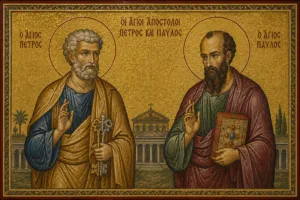
Every year on June 29, the Church joyfully celebrates one of her greatest feasts: the commemoration of the Holy, Glorious, and All-Praiseworthy Apostles Peter and Paul. Although very different in personality, background, and mission, these two great saints are united forever in Christ. Together they became the firm foundation upon which the Gospel spread throughout the world, and together they sealed their witness with the ultimate sacrifice of martyrdom.
The Byzantine Church beautifully proclaims during Great Vespers:
“What crowns of praise shall we weave for Peter and Paul?”
The answer unfolds throughout the entire feast: they are crowned because they loved Christ above all things, proclaimed His Gospel without fear, and offered their very lives for Him.
Saint Peter was a simple fisherman from Galilee. Originally named Simon, he was called by Jesus to leave his fishing nets and become a “fisher of men.” He was the first among the Apostles to confess, “You are the Christ, the Son of the living God.” In response, Christ gave him the name Peter—meaning “rock”—and entrusted him with a unique pastoral ministry within the apostolic college (Matthew 16:16-19).
Yet Peter was not perfect. He loved Christ deeply but also knew the pain of weakness when he denied the Lord three times during the Passion. His tears of repentance became a testimony that God’s mercy is greater than human failure. After the Resurrection, Christ restored Peter beside the Sea of Galilee with the threefold command: “Feed My sheep.”
Saint Paul’s story is equally remarkable. Born as Saul of Tarsus, he was a learned Pharisee and an energetic persecutor of the early Christians. Everything changed on the road to Damascus when the risen Christ revealed Himself to him. From that moment, Saul became Paul, dedicating every remaining day of his life to preaching the Gospel throughout Asia Minor, Greece, and finally Rome. His missionary journeys, his profound theological writings, and his unwavering courage helped shape the life of the early Church for every generation that followed.
One Apostle had walked beside Jesus during His earthly ministry. The other encountered the risen Lord after the Resurrection. One was sent especially to the Jewish people; the other became the Apostle to the Gentiles. Yet both proclaimed the same Gospel, the same Cross, and the same Resurrection of Christ.
Ancient Christian tradition tells us that both Apostles suffered martyrdom in Rome during the persecution of Emperor Nero around the years AD 64–67.
Because Peter did not consider himself worthy to die exactly as his Master had died, tradition tells us that he requested to be crucified upside down. Paul, being a Roman citizen, was spared crucifixion and was executed by the sword. Their earthly lives ended differently, yet both offered themselves completely to Christ.
Their tombs quickly became places of pilgrimage for Christians from every corner of the world. Today, the magnificent Basilica of Saint Peter stands over Peter’s tomb in the Vatican, while the Basilica of Saint Paul Outside the Walls preserves the memory of the Apostle to the Nations. From the earliest centuries, Christians honored both Apostles together as the two great pillars of the Church.
At first glance, Peter and Paul seem to have little in common. Peter was an uneducated fisherman. Paul was an accomplished scholar. Peter acted quickly with his heart; Paul often reasoned carefully with his mind.
Yet the Church celebrates them together because they reveal the fullness of God’s saving work.
Peter reminds us that faith begins with a personal encounter with Christ.
Paul reminds us that faith must then be proclaimed to the ends of the earth.
Peter represents steadfast pastoral leadership.
Paul represents tireless missionary zeal.
Together they reveal that the Church is both firmly rooted in apostolic faith and continually sent into the world to announce the Good News.
The hymns of Matins call them “the two luminaries of the Church, shining brighter than the sun,” because through them the light of Christ continues to illumine every nation.
Our joyful celebration is preceded by the Apostles’ Fast, known in the Ukrainian tradition as Petriwka (Петрівка). Beginning on the Monday after the Sunday of All Saints, this fast reminds us that every great feast deserves spiritual preparation.
Unlike the Great Fast before Pascha, the Apostles’ Fast is especially connected with missionary discipleship. Through prayer, fasting, confession, acts of charity, and participation in the Divine Liturgy, we ask God to renew within us the same courage and faith that burned in the hearts of Peter and Paul.
Fasting is never simply about food. It is about making more room for Christ in our lives.
The Feast of Saints Peter and Paul reminds us that holiness is not reserved for perfect people.
Peter teaches us that our failures do not define us when we sincerely repent.
Paul teaches us that no one is beyond God’s mercy and transforming grace.
Their lives proclaim one timeless truth: Christ calls ordinary people, forgives sinners, strengthens the weak, and sends His disciples to become witnesses to the Gospel.
This is why the Church continues to honor them with such solemnity. They did not simply speak about Christ—they gave their entire lives to Him.
As we celebrate this holy feast, may we ask ourselves the same question Jesus once asked Peter: “Do you love Me?” Our answer is found not only in our words, but in our willingness to follow Christ each day with faith, humility, courage, and love.
May the Holy and Glorious Apostles Peter and Paul intercede for our parish, our families, our Church, and our world, that we too may become faithful witnesses of the Risen Lord.
Holy Apostles Peter and Paul, pray for us!
“O Prophet and Forerunner of the coming of Christ, we who lovingly honor you are at a loss to praise you worthily; for your mother’s barrenness and your father’s silence were both ended by your honored and glorious birth, and the incarnation of the Son of God is proclaimed to the whole world.”
— Troparion of the Feast
Every year on June 24, in the midst of the Apostles’ Fast, the Church celebrates one of her oldest and most beloved feasts: the Nativity of the Honourable and Glorious Prophet, Forerunner and Baptist John.
At first glance, it may seem unusual. Why would the Church celebrate the birth of a saint? Normally, saints are commemorated on the day of their death—the day they enter eternal life.
Yet the Church makes only a few exceptions. She celebrates the birth of our Lord Jesus Christ, the birth of the Most Holy Mother of God, and the birth of Saint John the Baptist.
This alone tells us something extraordinary.
John is not simply another saint among many. He stands at the meeting point of the Old and New Covenants. He is the last and greatest of the prophets, and the first witness of Christ. All the prophets pointed toward the Messiah from afar. John pointed to Him standing before him and proclaimed:
“Behold, the Lamb of God who takes away the sin of the world!” (John 1:29)
The Gospel tells us that John’s parents, Zechariah and Elizabeth, were righteous before God but had no children. They were already advanced in years when the Archangel Gabriel appeared to Zechariah while he was serving in the Temple.
The evangelist Luke carefully notes that Zechariah belonged to the priestly division of Abijah. This small detail reminds us that the Gospel is not a legend floating outside of history. God entered a real world, among real people, at a specific moment in time.
Gabriel announced that Elizabeth would bear a son who would be “great before the Lord,” filled with the Holy Spirit even from his mother’s womb, and sent to prepare a people ready for the coming of the Messiah.
Zechariah struggled to believe. As a sign, he lost his ability to speak.
Months later, when the child was born, relatives wished to name him after his father. But Elizabeth insisted, “His name is John.”
When Zechariah wrote the same words on a tablet, his tongue was loosened and his first words became a hymn of praise to God.
The feast hymns beautifully summarize these two miracles:
“Your mother’s barrenness and your father’s silence were both ended by your honored and glorious birth.”
One of the most beautiful moments in all of Scripture takes place before John is born.
When the Virgin Mary visited Elizabeth after the Annunciation, carrying the Savior in her womb, the unborn John leaped for joy.
The Church sees in this event the first witness of the Forerunner.
Before he preached.
Before he baptized.
Before he spoke a single word.
He recognized Christ.
The liturgical hymns of the feast repeatedly return to this mystery: John is sanctified before birth because his entire life exists for one purpose—to reveal Jesus Christ.
John grew up far from the centers of power and influence.
He lived in the wilderness.
He fasted.
He prayed.
He called people to repentance.
Crowds traveled great distances to hear him.
Some even wondered whether he himself might be the Messiah.
Yet John’s greatness is found precisely in his refusal to place himself at the center.
Again and again he points away from himself and toward Christ.
His entire life can be summarized by one sentence:
“He must increase, but I must decrease.” (John 3:30)
No words better capture the spirituality of Saint John the Baptist.
For centuries Christians have noticed a remarkable harmony between this feast and the natural world.
The Nativity of Saint John falls near the summer solstice, when daylight reaches its greatest length in the Northern Hemisphere.
After this point, the days slowly begin to shorten.
Six months later comes the Nativity of Christ near the winter solstice, when daylight begins to increase once again.
The Church does not present this as scientific proof of historical dates. Rather, Christians have long seen a beautiful spiritual symbolism in the relationship.
John says:
“He must increase, but I must decrease.”
After John’s feast, daylight decreases.
After Christ’s feast, daylight increases.
As if creation itself quietly echoes the mission of the Forerunner.
Ancient Christian tradition linked John’s birth and Christ’s birth through the Gospel of Luke, which tells us that Elizabeth was already six months pregnant when the Archangel Gabriel announced the conception of Jesus. The liturgical calendar preserves this sacred relationship between the Forerunner and the Lord.
The theology of this feast is perhaps expressed most beautifully in its liturgical texts.
The Kontakion proclaims:
“She who once was barren gives birth today to the Forerunner of Christ, who will fulfill every prophecy. In the Jordan he placed his hand upon the One whom the prophets foretold and thus was shown to be the prophet, the herald, and the Forerunner of the Word of God.”
The liturgical readings also reveal the deeper meaning of John’s life.
The Old Testament readings at Vespers recall miraculous births granted by God and the promises spoken through the prophets. The Epistle calls believers to cast off the works of darkness and put on the armor of light. The Gospel recounts the angel’s announcement, John’s birth, and Zechariah’s prophecy.
Everything points toward one truth:
John prepares the way.
Christ fulfills it.
John is the voice.
Christ is the Word.
John is the lamp.
Christ is the Light of the world.
In a world where people often seek attention, recognition, and applause, Saint John teaches a very different path.
He was admired by thousands.
Yet he never made himself the center.
His greatness came from humility.
His mission was not to draw others to himself, but to lead them to Christ.
That remains his message today.
Every Christian is called, in some way, to become a forerunner.
In our families.
In our parishes.
In our communities.
Not by drawing attention to ourselves, but by helping others encounter the Lord.
Holy Prophet, Forerunner, and Baptist John,
you rejoiced in the presence of Christ even before your birth.
Teach us to recognize the Lord as you did.
Help us prepare the way for Him in our hearts.
Give us your courage to speak the truth,
your humility to point beyond ourselves,
and your faithfulness to remain steadfast until the end.
That, like you, we may always proclaim:
“He must increase, but I must decrease.”
Amen.