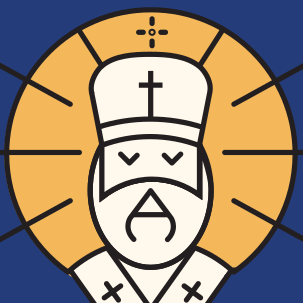
Saint Demetrius: The Brave Christian Whose Tomb Flowed with Fragrant Myrrh
Monday, October 26, 2026
“The word of God is not chained.” — 2 Timothy 2:9
Imagine being told that you must stop speaking about Jesus. Imagine being thrown into prison simply because you believe in Him. Would you still have the courage to stand up for your faith?
More than 1,700 years ago, a Christian named Demetrius faced this very choice. He chose Christ, even when it cost him his life. Today, the Ukrainian Catholic Church honours him as the Holy and Glorious Great-Martyr Demetrius, the Myrrh-Streamer.
His feast is celebrated on Monday, October 26, with an All-Night Vigil rank. The faithful are highly encouraged to participate in the Divine Liturgy and give thanks to God for the life and witness of this beloved saint.
But Saint Demetrius’s story is more than a story about a brave man from long ago. It is a story about courage, friendship, faith, and a mystery that attracted pilgrims from far away.
1. Who was Saint Demetrius?
Saint Demetrius lived in Thessalonica, an important city in the Roman Empire, in the late third and early fourth centuries. The city is still called Thessaloniki today and is located in northern Greece.
According to Church tradition, Demetrius came from a distinguished family and held an important position in society. He was educated, respected, and influential. Yet he understood that no earthly honour was greater than belonging to Jesus Christ.
At that time, Christians could be persecuted for refusing to worship the Roman gods. Demetrius openly professed his faith and encouraged others to follow Christ.
This eventually led to his arrest and imprisonment. Traditional accounts place his martyrdom around the year 306, during the persecutions associated with the Roman emperor Galerius Maximian.
A fascinating fact: Saint Demetrius is especially connected with Thessalonica, where a magnificent church was built in his honour. For centuries, Christians have regarded him as the heavenly protector of the city.
Today, his feast is celebrated throughout the Byzantine Christian world, including in our Ukrainian Catholic Church.
2. A young man, a mighty fighter, and a courageous saint
One of the most exciting stories associated with Saint Demetrius involves a young Christian named Nestor and a powerful fighter named Lyaeus.
According to the traditional account, Lyaeus was known for defeating his opponents in public contests. The emperor’s games made him a symbol of strength and victory.
Nestor, a young man who knew Demetrius, wanted to face this fighter. Before entering the contest, he went to the imprisoned Demetrius and asked for his blessing.
Demetrius encouraged him. Trusting in God’s help, Nestor confronted Lyaeus and defeated him.
The emperor was furious. Nestor was sentenced to death, and Demetrius was also ordered to be killed.
The Church commemorates Saint Nestor on October 27, the day after Saint Demetrius.
This story is remembered in the troparion sung for Saint Demetrius:
“As you smashed the pride of Lyaeus, encouraging Nestor to struggle, pray to Christ our God to grant great mercy to our souls.”
Notice something important: the hymn does not simply celebrate a physical victory. It remembers Demetrius as someone who encouraged another person to be courageous.
For children to think about: Have you ever been afraid to do the right thing because you thought others might laugh at you? Have you ever needed a friend to encourage you?
Sometimes, being a good Christian means being the friend who says, “Don’t give up. Do what is right. God is with you.”
Of course, Christian courage is not about hurting others or proving that we are stronger. It is about choosing what is right, even when it is difficult.
3. Why is Saint Demetrius called the Myrrh-Streamer?
Here is one of the most unusual parts of Saint Demetrius’s story!
The word myrrh refers to a fragrant substance associated with perfume, anointing, and burial in the ancient world. The name Myrrh-Streamer comes from the Christian tradition that fragrant myrrh flowed from the area of the saint’s tomb and his holy relics.
In Greek, he is called Myrovlitis, meaning “the one who streams myrrh.”
After his death, Christians honoured Demetrius at his burial place in Thessalonica. Over time, a church was built there, and the faithful came to pray and seek his intercession. Reports of fragrant myrrh became an important part of his veneration.
The great Basilica of Saint Demetrius in Thessalonica remains a historic centre of devotion to the saint. The church was severely damaged by a great fire in 1917 and later restored.
Did you know? The ancient city of Thessalonica was an important place in the Bible, too! Saint Paul visited the city and wrote two letters to the Thessalonians, which are included in the New Testament.
The city that heard the preaching of Saint Paul later became famous throughout the Christian world for its devotion to Saint Demetrius.
What a beautiful connection: the Gospel was preached in Thessalonica, Christians continued to live their faith there, and the memory of a faithful martyr has been preserved for centuries.
The tradition of myrrh also invites us to consider a deeper spiritual question. What fragrance does our own life leave behind?
Saint Paul writes that Christians are called to be “the aroma of Christ” (2 Corinthians 2:15).
We may not leave a physical fragrance behind us, but we can leave the fragrance of kindness, forgiveness, generosity, and love. People may remember us because we helped them when they were lonely, forgave them when they made a mistake, or encouraged them when they felt discouraged.
That is a beautiful way to honour Saint Demetrius.
4. A mystery of faith: Can you chain the Word of God?
One of the appointed readings for this feast comes from Saint Paul’s Second Letter to Timothy.
Saint Paul writes:
“Remember Jesus Christ, raised from the dead.”
And then he declares:
“The word of God is not chained.” (2 Timothy 2:9)
Think about that for a moment.
A person can be put behind bars. A church can be closed. A Bible can be taken away. A Christian can be threatened for speaking about Jesus.
But can anyone stop God’s truth from reaching another human heart?
Saint Paul wrote these words while suffering imprisonment. Saint Demetrius also suffered because of his faith. Yet their witness continued beyond their lifetimes.
Today, we read Saint Paul’s words in our churches. We sing hymns in honour of Saint Demetrius. Parents teach their children to pray, and grandparents pass on the faith to their grandchildren.
The Word of God continues to be heard!
A little challenge for young readers: Can you name three ways you can share God’s Word without standing in front of a crowd or giving a speech?
Perhaps you can forgive your brother or sister, stand beside a child who is being bullied, pray for someone who is sick, or tell a friend why you believe in Jesus.
You do not need to be famous to share the Gospel. You only need to begin where God has placed you.
5. Does following Jesus mean everyone will like us?
The Gospel reading for Saint Demetrius’s feast comes from John 15:17–16:2.
Jesus tells His disciples:
“I am giving you these commands so that you may love one another.”
But He also warns them that the world may reject them because they belong to Him.
How can these two teachings belong together? Jesus commands us to love others, yet He tells us that some people may hate us.
Jesus is teaching us that love does not always make life easy. Sometimes people will not understand why we refuse to cheat, why we forgive someone who has hurt us, or why we defend a person who is treated unfairly.
The Gospel does not tell us to hate those who disagree with us. Instead, it calls us to remain faithful to Christ and continue loving others.
Saint Demetrius did not abandon his faith to protect his earthly position. He remained faithful, even when he faced persecution.
For children and adults alike, this is an important lesson: We do not need everyone to approve of us in order to do what is right.
If someone laughs at you because you pray, tells you that being honest is foolish, or pressures you to join in something wrong, remember that you can be kind without giving up your convictions.
Jesus also promises His disciples the Holy Spirit, the Advocate and Spirit of truth, who will testify about Him. The disciples are called to bear witness, too.
We are not left to follow Christ through our own strength alone. We ask the Holy Spirit to guide us, strengthen us, and help us love even when love is difficult.
6. What does the Church teach us through the hymns?
The Byzantine hymns for Saint Demetrius are short, but they contain a great deal of theology.
The troparion calls him a champion in the world’s struggles and remembers how he encouraged Nestor. It asks him to pray to Christ for mercy.
The kontakion gives us another striking image:
“With the streams of your blood, O Demetrius, God, who gave you invincible strength, has dyed the Church in royal crimson.”
Royal crimson is the colour of kings. In the hymn, the martyr’s blood becomes an image of the dignity and victory of the Church’s faithful witnesses.
This does not mean that violence is good. It means that the world cannot defeat the truth of Christ simply by killing those who proclaim it.
The hymn also remembers Thessalonica as the city protected by Saint Demetrius’s prayers. Christians have long turned to him as a heavenly protector, asking him to intercede for their city and its people.
The Church’s hymns always bring us back to Christ. Saint Demetrius is not worshipped as God; he is honoured as a servant of Christ whose life points us toward the Lord.
We ask the saints to pray for us, just as we ask our fellow Christians to pray for us. All salvation and grace come from God.
7. A feast for the whole family
Saint Demetrius’s feast is a wonderful opportunity for families to speak about faith in a way that children can understand.
Parents can ask their children:
- When is it difficult to tell the truth?
- How can we help a friend who is afraid?
- What should we do when someone treats us unfairly?
- How can we show love to someone who does not like us?
- What is one thing we can do this week to follow Jesus more faithfully?
There is no need for children to give perfect answers. The important thing is to help them see that holiness begins in everyday life.
Adults can ask themselves the same questions. Do we encourage others in their faith? Do we remain honest when dishonesty would be easier? Do we pray for those who hurt us? Do our children see the love of Christ in our actions?
Saint Demetrius reminds us that faith is not merely something we talk about. It is something we live.
8. Let us celebrate Saint Demetrius
Monday, October 26, is the feast of the Holy and Glorious Great-Martyr Demetrius, the Myrrh-Streamer.
Because this is a feast of All-Night Vigil rank, the faithful are highly encouraged to participate in the Divine Liturgy. Together, we give thanks to God for His grace in the life of Saint Demetrius, listen to His Word, and pray for the courage to remain faithful to Christ.
The Church remembers Saint Demetrius because he remained faithful when faith was costly. His story encourages us to be courageous, to strengthen one another, and to love even when we face rejection.
May Saint Demetrius pray for our children, our families, our parish, and all who are suffering or afraid. May the Lord give us the strength to stand for truth without hatred, to forgive without pride, and to serve others with generous hearts.
And may we remember the words of Saint Paul:
“The word of God is not chained.”
Holy Great-Martyr Demetrius, pray to Christ our God for us!
A little Saint Demetrius quiz!
Can you answer these five questions?
- Where did Saint Demetrius live?
Thessalonica, in present-day northern Greece. - Who was the young Christian encouraged by Saint Demetrius?
Saint Nestor, commemorated on October 27. - What does “Myrrh-Streamer” mean?
It refers to the tradition that fragrant myrrh flowed from the area of the saint’s tomb and relics. - Which apostle wrote letters to the Christians of Thessalonica?
Saint Paul. - What is the most important lesson of Saint Demetrius’s life?
To remain faithful to Jesus Christ, encourage others in faith, and love even when it is difficult.
Family challenge: Choose one act of courage and kindness to practise this week. Tell the truth when it is difficult, invite someone who feels left out to join you, forgive someone, or pray for a person who is struggling. Then remember Saint Demetrius and thank God for giving us holy examples to follow.
Святий великомученик Димитрій Мироточець
26 жовтня
Святий Димитрію, навчи нас бути мужніми у вірі та сильними в любові!
Хто був святий Димитрій?
Святий великомученик Димитрій жив у місті Солуні (тепер Салоніки, Греція) наприкінці III — на початку IV століття. Він походив із поважної родини й був римським військовим. Але найбільшим скарбом його життя була не військова слава, а віра в Ісуса Христа.
У той час християнам було небезпечно відкрито визнавати свою віру. Імператори вимагали, щоб люди поклонялися язичницьким богам. Проте Димитрій не хотів приховувати, що він християнин.
Він не тільки сам вірив у Христа, а й навчав інших людей любити Бога, робити добро та жити за Його заповідями. Його слова допомагали людям ставати кращими й знаходити надію.
Коли імператор дізнався про його віру, Димитрія ув’язнили. Йому загрожувала смерть, але він не зрікся Христа. Зрештою святий прийняв мученицьку смерть за свою віру.
Димитрій був сильним не тому, що мав зброю, а тому, що не хотів відмовитися від Христа.
Молодий Нестор і сильний воїн
Історія святого Димитрія пов’язана також із молодим християнином на ім’я Нестор.
У Солуні жив сильний воїн Лій, який боровся з іншими людьми на очах у натовпу. Він часто перемагав, а переможених принижували й жорстоко карали.
Молодий Нестор вирішив виступити проти нього. Перед цим він прийшов до святого Димитрія, який перебував у в’язниці, і попросив його благословення.
Димитрій благословив юнака, і Нестор вийшов на боротьбу з Лієм. За церковним переданням, він переміг сильного воїна.
Це розгнівало імператора. Нестора засудили до смерті, а невдовзі загинув і святий Димитрій.
Ця історія нагадує нам, що мужність не залежить від віку чи сили тіла. Навіть молода людина може зробити правильний вибір, якщо довіряє Богові.
Але справжня мужність — це не бажання перемогти інших або принизити їх. Це готовність захищати правду, допомагати слабшим і залишатися вірним Богові навіть тоді, коли це нелегко.
Чому святого називають Мироточцем?
Після смерті святого Димитрія християни продовжували молитися біля його гробниці в Солуні. Згодом там було збудовано великий храм, присвячений святому.
За церковним переданням, від мощей святого витікало запашне миро — особлива запашна рідина. Люди приходили сюди з вірою, просили Божої допомоги й розповідали про отримані благодаті.
Саме тому святого називають Димитрієм Мироточцем.
Його храм у Солуні став одним із найвідоміших християнських храмів. Протягом багатьох століть сюди приходили паломники, щоб молитися, дякувати Богові та просити заступництва святого.
Важливо пам’ятати: святі не замінюють Бога. Ми просимо їх молитися за нас, а вся благодать і допомога походять від Господа.
Що святий Димитрій говорить нам сьогодні?
Можливо, ми думаємо: «Святий Димитрій був воїном. Що його життя може навчити мене? Я ж не живу в ті часи й не повинен боротися на полі бою».
Але кожен із нас щодня зустрічається з маленькими випробуваннями.
- Коли інші насміхаються з когось, чи маємо ми мужність стати поруч із цією людиною?
- Коли можемо сказати неправду, чи вистачає нам сили сказати правду?
- Коли хтось нас образив, чи можемо ми пробачити?
- Коли ніхто нас не бачить, чи стараємося ми все одно чинити добро?
- Коли важко молитися або ходити до церкви, чи продовжуємо ми шукати Бога?
Ось де потрібна справжня мужність!
Святий Димитрій не дозволив страхові керувати своїм життям. Він залишився вірним Христові. Ми також покликані бути вірними Богові у своїй родині, школі, на роботі та серед друзів.
Бути християнином означає не лише говорити про Ісуса, а й показувати Його любов своїми вчинками.
Що ми чуємо в богослужінні?
У день святого Димитрія Церква прославляє його у вечірньому богослужінні та Божественній Літургії.
В апостольському читанні (2 Тимотея 2:1–10) святий Павло закликає Тимотея бути сильним у Божій благодаті та витривалим у служінні Христові. Павло сам терпів за Євангеліє, але продовжував проповідувати, бо знав, що Слово Боже не можна ув’язнити.
Ці слова добре пояснюють життя святого Димитрія. Його могли ув’язнити, але не могли змусити перестати любити Христа.
У Євангелії (Івана 15:17–16:2) Ісус попереджає Своїх учнів, що світ не завжди прийматиме їхню віру. Ісус не обіцяв, що життя з Ним буде завжди легким. Але Він закликав учнів залишатися в Його любові й не втрачати віри.
Святий Димитрій прийняв ці слова всім серцем. Він залишився вірним Христові навіть перед лицем смерті.
У церковних піснеспівах ми також чуємо про мужність мученика, його вірність Богові та перемогу над злом. Для християнина найбільша перемога — це не перемога над іншою людиною, а перемога любові над ненавистю, правди над неправдою і віри над страхом.
Цікаві запитання для дітей і родин
1. Де жив святий Димитрій?
У місті Солуні, яке сьогодні називається Салоніки й розташоване в Греції.
2. Чому його називають великомучеником?
Тому що він прийняв тяжкі страждання і смерть, залишаючись вірним Ісусові Христові.
3. Хто такий святий Нестор?
Молодий християнин, який, за церковним переданням, отримав благословення святого Димитрія перед боротьбою з воїном Лієм.
4. Чому Димитрія називають Мироточцем?
Тому що, за церковним переданням, від його мощей витікало запашне миро.
5. Як ми можемо наслідувати святого Димитрія?
Молитися, говорити правду, захищати слабших, прощати образи й не соромитися своєї віри.
Невелика думка на завершення
Святий Димитрій жив багато століть тому, але його приклад залишається близьким і сьогодні.
Він нагадує нам, що не потрібно бути відомою чи дуже сильною людиною, щоб служити Богові. Потрібно мати відкрите серце, щиру віру та готовність робити добро.
Нехай святий Димитрій допомагає нам бути мужніми у важкі хвилини, вірними Христові та уважними до людей, які потребують нашої любові.
Святий великомученику Димитрію Мироточцю, моли Бога за нас!
